
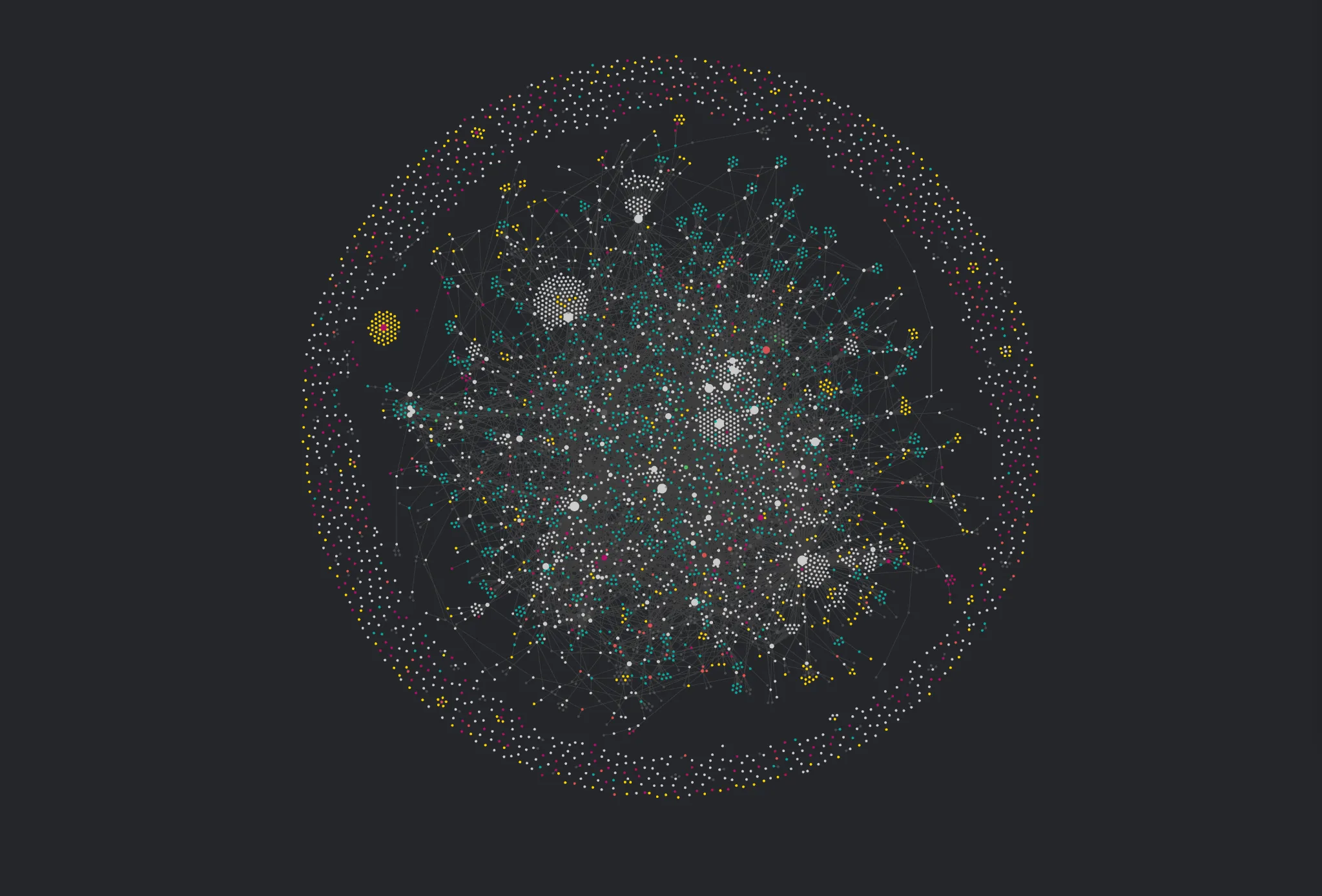
When I first dipped my toes into Obsidian back in 2021, I’d already decided what I wanted to get out of it.
About five years and 5,000+ notes later, this goal hasn’t changed a bit.
But the world around me has changed beyond recognition. The biggest change of all, of course, has been the rise of large language models.
So, naturally, there’s been a lot of chatter about bringing AI into Obsidian: connecting Claude to your vault, getting agents to work on your notes, all that jazz.
I gotta admit, the possibilities are pretty interesting. It can summarise notes, find connections between them, and even can turn scattered ideas across many notes into clear arguments.

With all that at our fingertips now, why do any of it manually?
Well… I’m not quite convinced about all these promises.
It all comes back to the goal I set all those years ago. If I use AI to do these things for me, am I really creating knowledge?
Probably not.
The more I think about this, the more I’m reminded of a folk story I heard growing up.
It goes like this…
There’s this man who lives in a small house with a huge moringa tree growing right in front of it.
Called the “tree of life”, moringa provides not one but two food resources: edible leaves and young pods.

One day, the man starts thinking: what if I sell all these pods and leaves and make some money from them?
If he keeps at it, eventually he’ll have enough money to buy a cart.
That’d be great.
He’d be a man of means in the village. Then he could easily find someone to marry.
What a brilliant plan.
Feeling rather pleased with himself, he dreams of the day he brings his new bride home in his new cart.
But then he realises there’s a slight problem.
The moringa tree blocks the entrance to his house, so there’s not enough room for the cart to get through.
“Stupid tree,” he growls.
Then he picks up an axe and cuts it down…

This is exactly what I see happening with some of these AI workflows in Obsidian.
If I let AI do everything for me, I risk undermining the very thing I wanted to do in the first place: create knowledge.
And the worst part is, just as the moringa tree promises him so much, AI, too, offers to do so much more than we could ever manage on our own that we easily lose sight of why we make notes in the first place.
Quite dangerous, this.
For example, here’s my book review workflow in Obsidian, which I established long before the current wave of AI tools.
- As I read a book, I highlight passages. If I’m reading an ebook, I also like to colour-code those highlights.
- Then I manually export them into Obsidian.
- After a couple of days, I go through the highlights one by one, making notes, checking references, and going back and forth between my notes and the book.
- Finally, I bring together the highlights around a few themes that emerge and write a review.
This is a long process. Sometimes, it takes as much time as reading the book itself.
But now, with these AI workflows, I could get from highlights to a finished review in just a couple of steps.
It’ll probably take a couple of minutes.
That’d be way less hassle than manually exporting everything, reading hundreds of highlights, and writing a review.
But would I develop the same understanding if I outsourced all that work to AI?
I don’t think so.
The knowledge crystallizes as I work through those highlights, trying to figure out what they mean and how they fit together.
It emerges through the process, not just by having a finished review.
The struggle is just as important a part of this.
Looking through some threads in the Obsidian subreddit, I came across a label for people who think this way: Obsidian purists.
Yes, this is a real term on the internet now!
But, as much as I’d like to count myself among them, I can’t.
Because I do use AI in my Obsidian vault sometimes.
Am I contradicting myself?
I’m not.
Because my whole argument about not using AI in Obsidian comes back to creating knowledge.
Some of the things I do every day don’t contribute much to that. In these cases, the friction involved is just wasted effort.
This is where AI comes in pretty handy.
For example, sometimes when I’m reading an article or a book highlight, I come across an interesting phrase that I’d like to use in my own writing when the right occasion comes along.
I could, of course, look it up on Google. But that means leaving Obsidian, searching, and coming back, which interrupts my train of thought.
The extra time spent switching back and forth doesn’t add anything to my understanding. It’s just busywork.
So this was a good place to use AI.
The AI Assistant in the QuickAdd community plugin works well in a case like this. In my setup, the only content from my vault sent to the model is the word or phrase I’ve highlighted, along with my instructions.
To save even more time, I trigger it with a keyboard shortcut: Option + D.
This entire workflow is explained in detail alongside all the necessary resources here.
So the principle guiding my use of AI is this: Automate transportation, not transformation.
With this philosophy, we can still bring the bride home in our cart, without cutting down the tree that made it all possible.
