
One-line takeaway
Deliberate practice is one of the most efficient tools for getting good at any craft.
What is Bounce: Mozart, Federer, Picasso, Beckham, and the Science of Success about?
In Bounce, Matthew Syed argues that talent, as it’s been marketed in today’s world, is overrated and that it’s just the tip of the iceberg. What lies beneath it, he says, is years-long practice. Deliberate practice, to be precise.
The book had me hooked from the beginning where he laid out his own story of becoming a world-class table tennis player. He argues that he was lucky to have (1) a professional-grade table tennis table available to him from early childhood and (2) someone to play with him hours on end every single day: his brother. This compounding of deliberate practice over many years, while the average kid did not have those head starts, he says, is what led him to become the world-class player he became later, not just raw talent.
He goes on to draw on many examples from many different domains to strengthen this argument in the following sections that expand its scope to show how feedback loops, early childhood access, and even sometimes the sheer luck of being born in the early months of the year could have an invisible grip on someone’s success.
While this book provides a “necessary correction” to how we think about “being good at something”, I find that it’s trying to overclaim it by bringing about the idea that you can be whoever you want to be with the right amount of practice.
Table of Contents
Ideas and takeaways
Pushing a hypothesis and presenting it to the general public should be done carefully, so as not to bend reality. I don’t think this book has done that with enough care. There are so many holes in the main argument.
It’s like you ordered a pizza and, while it’s on the way, realized that you promised yourself to cut the carbs. What you’ll have to do, then, is eat the few vegetables that came as toppings and throw out the rest. And you’ve paid 25 bucks for it already!
This is how I felt reading this book, only with money swapped for reading time. There was too much unwanted carb in it.
That said, there is still some genuinely useful information tucked in there. Here is some of it:
Practice and deliberate practice are two very different things
Syed points out that the way someone practices their craft is particularly important to get ahead of the average, and doing the same stuff over and over again would not get someone that far.
These deliberate practice runs include:
- focusing on the weaknesses after each and every practice run, and putting more time and effort on them,
- constantly trying to beat the past score,
- and getting feedback from others.
I find this to be one of the most useful and important parts of the whole book.
Competence at early ages can be mistaken for natural talent
Drawing on examples from his own childhood, Syed points out that some kids may have the resources for practice that provide them with enough practice hours to get ahead of the average person. This, in the long run, will help them to naturally get better and easily beat the average.
But the younger this happens, the easier it is for the outside world to mistake them for child prodigies.
Syed is absolutely right to challenge this conventional narrative, and he has his own life’s story to back it up.
Our brains can be physically altered, especially at younger ages
Deliberate practice does not only train muscles; it trains the brain, too.
Research already shows that our brains are open to change and that repeated practice can alter their physical structure. The tendency for this to happen is especially pronounced when we’re kids.
This ability of the brain to change in response to experience is called “neuroplasticity.”
It’s a constant dance between nature and nurture.
Where I’d push back: good performance does not necessarily guarantee success
As mentioned before, Syed tries to reposition the conventional belief that “talent is king”, which is somewhat out of place. But he does it with such force that it makes the whole argument collapse under its own weight.
There are two places where it really shows.
First, practice is indispensable, yes, but it accounts for only a limited part of the variation in someone’s performance.
Nobody can reach the elite level in anything competitive without a considerable amount of practice. There’s enough evidence for this. It goes without saying. And the more deliberately one does it, the less time it’ll take them to reach a certain level. But what’s interesting is that the effect of deliberate practice on performance does not follow the same pattern across different domains.
For example, here are the proportions of variation in performance explained by deliberate practice, according to a well-cited meta-analysis published in Psychological Science:
- 26% of performance differences in games
- 21% in music
- 18% in sports
- 4% in education
- less than 1% in professions
So, yes, practice is important, but it’s not the whole ball game.
Practice can absolutely get someone from square one to “good” pretty quickly, but when it comes to “good versus best”, the amount of practice starts to lose its grip on the equation Syed has been building throughout the book.
Especially in the later part of the book, the arguments lean towards the idea that practice defines anyone’s success in a linear fashion.
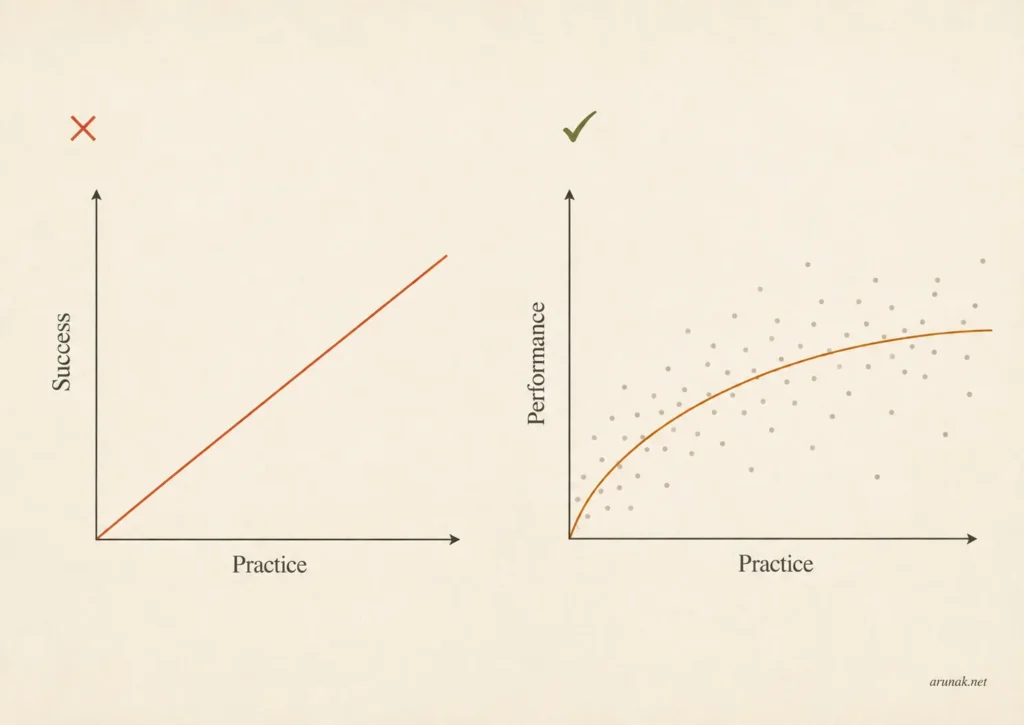
This brings me to my second point: practice affects performance, but it does not guarantee eventual success. They are two different things.
The deliberate-practice research discussed here measures performance, not real-world success. To be able to be successful with the skills acquired, one has to navigate the messiness of real life: mental steadiness, finances, access to opportunities, timing and sheer luck.
But the more I read towards the end of the book, the more it seemed to me that the argument was trying to merge performance with success by flattening this uncomfortable middle.
Final words
That said, while the book conceptually fails as a whole, it still leaves you with so many useful nuggets of information.
I’d recommend it to anyone, especially parents with young children, whom I see as perhaps the best audience for this kind of book.