

One-line takeaway
Cooperation allows a group with less expertise to outperform a more experienced one.
What is The Culture Code: The Secrets of Highly Successful Groups about?
This is a great reference for anyone who wants to learn how to perform well in a group setting. Its lessons apply to both team members and leaders.
The top three lessons from the book are: (1) cooperation beats individual expertise; (2) greed is a major factor that holds a group back from succeeding; and (3) the most successful groups focus on solving hard problems first, sometimes even at the expense of collective happiness.
Collective intelligence can outperform individual expertise
The book starts with one of the most compelling examples of collective intelligence: Peter Skillman’s marshmallow challenge. The challenge was to build the tallest structure from spaghetti, tape, string, and a marshmallow.
The contestants were as unusual as the challenge itself: kindergartners and graduate-level business students.
Kindergarteners won each and every time.
Having less knowledge about structural engineering and project planning, how did they pull this off?
The answer can be summarized in one word: cooperation. They spend less time negotiating roles and status and more time experimenting, learning from failure, and treating one another as equals.
Later in the book, Coyle returns to the same idea with another intriguing story. But this time, the stakes are life or death. On July 19, 1989, an engine failure aboard United Airlines Flight 232 destroyed all three hydraulic systems. The crew lost the flight controls. With the grudging realization that this could end up with them losing all of their lives, everyone immediately set their status aside. They started communicating in short bursts. Captain Al Haynes invited ideas from his crew and made it clear that he needed everyone’s help.
The crew exchanged questions, ideas, and requests, more than sixty per minute, which Coyle calls “notifications.” And it worked. This collective effort helped 185 of the 296 people aboard survive the crash.
Greed in a group setting holds people back from succeeding
It can even cost someone quite a lot of money. Coyle writes, “Passing the ball instead of shooting is the equivalent of handing a teammate $28,161.24.” This relates to a study of NBA players that found that each field goal was associated with a $22,044.55 increase in the player’s subsequent salary, while each assist was associated with a $6,116.69 decrease.
The most successful groups and organizations focus on solving really hard problems more than on making everyone collectively happy.
But this does not mean that high-performing groups are miserable. They create psychological safety within the group, but they use it to establish common ground. This gets fear, insecurity, and concerns about status out of the way so they can focus on the problems at hand.
Good ideas can easily turn into real outcomes through personal interactions
Coyle calls these types of quick interactions “collisions”. They are unplanned, person-to-person encounters through which people exchange ideas, ask questions, observe other people’s behaviour, and absorb otherwise unspoken knowledge.
For example, Tony Hsieh, the former CEO of Zappos, designed Zappos’s headquarters and his Downtown Las Vegas project to encourage these types of interactions. He called the time available for these encounters “collisionable hours.”
Smaller things that we would not even consider to be productivity boosters can make all the difference
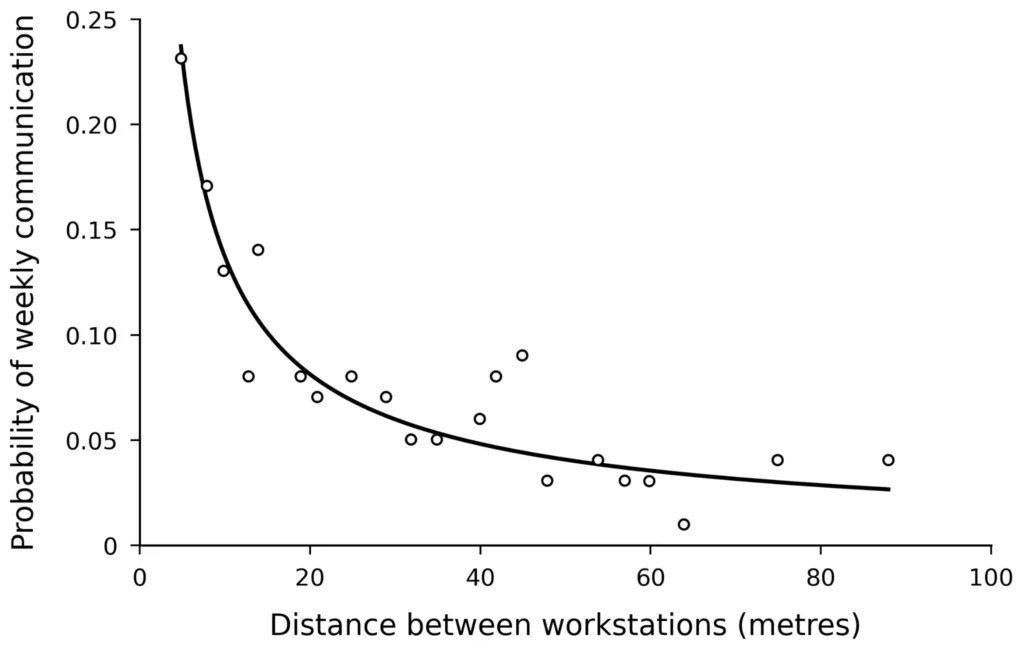
The quality of the outcomes of engineering projects was found to correlate with how close the team members’ desks were, rather than with their intelligence or experience. This is because when people sit close to each other, they are more likely to communicate better, and more often. This behavior can be better understood through the Allen Curve, which shows how quickly communication drops as the distance between two people increases.
The number of groups in a group is as important as the working distance. Dunbar’s number suggests that we can maintain stable relationships with about 150 people at a time.
Embrace the messenger who tells you the bitter truths
We can only see so many of our own shortcomings. So, if we want a 360-degree view of the type of mistakes we make, we need an outsider’s perspective. Constructive criticism is crucial for us to get better at whatever we do.
Most importantly, we should make sure that it’s reoccurring. When someone brings us a bitter truth that’s quite hard to hear but makes complete sense, it’s really important to embrace that person and then correct the mistake. This way, they will be comfortable bringing us more bitter truths later. Eventually, this creates a healthy feedback loop that helps us improve at whatever we do ourselves massively.
Eliminate bad apples
In any given group, there is often a person or two who is responsible for the majority of the problems. These are the ones who are holding the group back.
Coyle’s suggestion is to first confront their behaviour directly. If that does not work, the best next step is to remove them from the group rather than letting them spread their negativity to the rest of the group.
The New Zealand All Blacks follow this rule to a tee. They call it “No Dickheads”, which means that no amount of talent excuses behaviour that harms the team.
Great leaders always find ways to get in the trenches
When someone is leading the group, over time, it’s quite easy for them to lose their humility and think that they are above everyone else. More often than not, this does not sit well with other people.
So, what a great leader does is put themselves on the same level as everyone else and find small tasks, however mundane, to do, signalling to others that “we are in this together”. Coyle calls this “muscular humility.”
For example, senior players on New Zealand’s All Blacks rugby team clean their own locker room after matches. They call this ritual “sweeping the sheds”.
A good predictor of success is how often you reach out for help
Whether you are starting a new job, moving to a new city, or taking on a new project, there are too many unknowns, and that makes you uncomfortable. The easiest and fastest way to overcome this is by learning from others and asking for help.
No matter how resourceful and capable you are, there is always someone who can help you fill the gaps in your knowledge. There is always something hiding in your blind spot that someone else has already figured out.
“So here’s how we’ll know if you had a good day,” Reinhardt continued. “If you ask for help ten times, then we’ll know it was good. If you try to do it all alone…” His voice trailed off, the implication clear—It will be a catastrophe.
