
The Story Phase
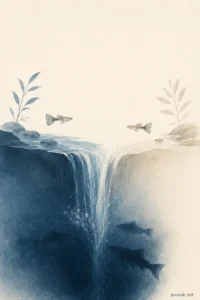
In the mountain streams of Trinidad, there live some grubby little fish called guppies. These streams are well known for their majestic waterfalls. But for these guppies, these waterfalls are also “the dividers of worlds”: the world below the falls, and the world above them.
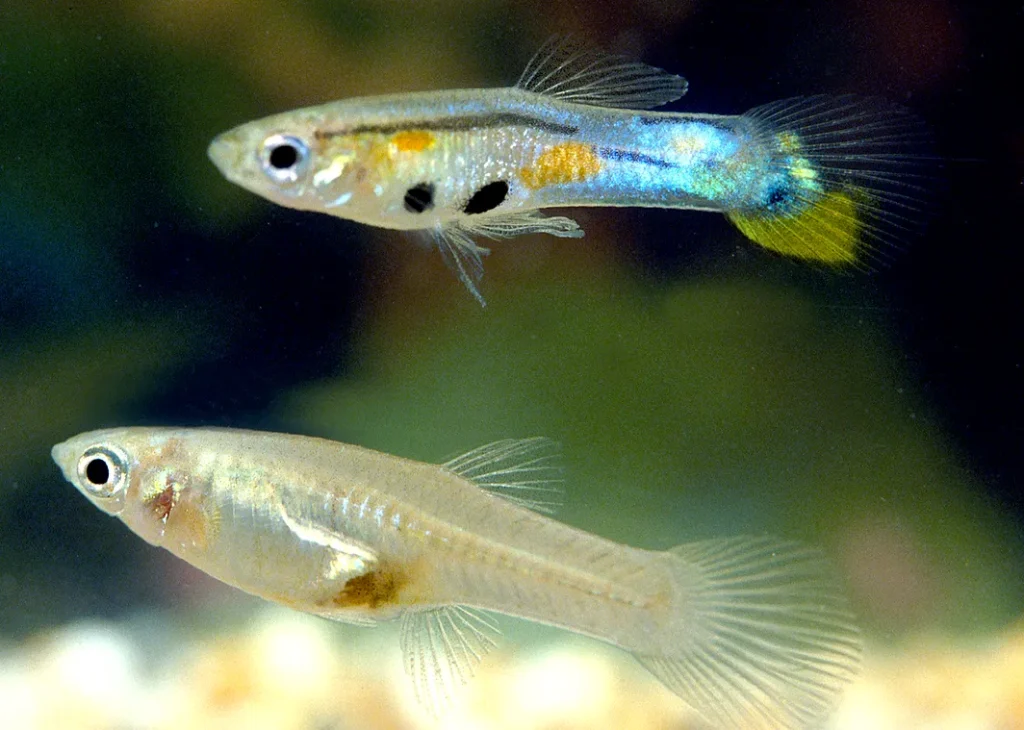
Below the falls is a dangerous place, with predators all around. But these predators cannot easily reach the streams above the falls. So, over many generations, the guppies living in these two very different environments slowly adjusted their personalities to match their respective environments. The ones below the falls—with predators—naturally became more risk-averse, whereas the ones above the falls tended to become more bold and careless.
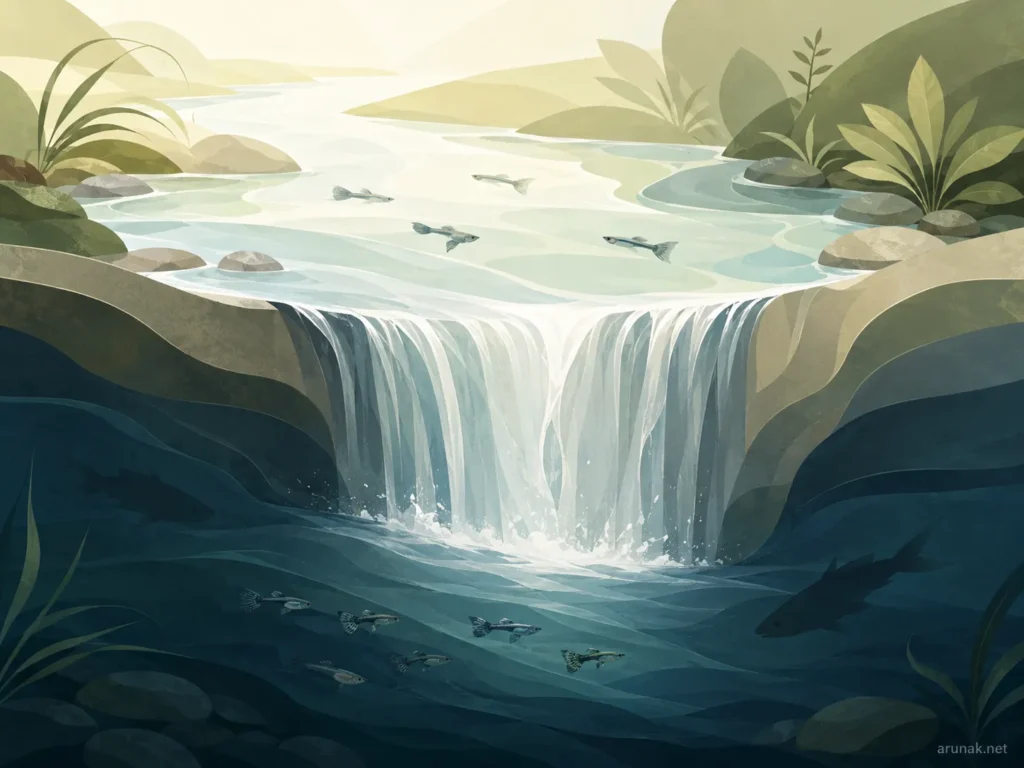
So what would happen if you took both groups and put them in the same environment that mimics the below-the-falls conditions, that is, with real predatory pressure? This is exactly the kind of thing Dr. David Reznick—an evolutionary biologist who has spent decades studying guppies in Trinidad—and his team did. The results are nothing but what you’d already imagine: the guppies who had been living in the high-predator environment (HP guppies) did exceptionally well at surviving compared to the guppies living in low-predator environments (LP guppies).
When they were placed into a tank with a guppy predator, after 36 hours, 14 out of 20 HP guppies were still alive. And only 5 LP guppies out of 20 were left. After 60 hours, every LP guppy was gone. But 8 of the 20 HP guppies were still alive.
And apart from survival, they were doing surprisingly well in the reproduction department as well. Dr. David Reznick’s studies showed that high-predation guppies matured earlier, had higher levels of reproductive effort throughout their lives, had lower mortality rates, and lived longer than low-predation guppies when both were compared in the same laboratory environment.
So, it’s a no-brainer that the HP guppies had won the natural selection lottery, and, sooner or later, the LP guppies would meet their downfall.
Wrong!
Reznick’s own results point to the opposite:
If the HP phenotype looks so clearly superior in the lab, then the LP phenotype should never evolve. And yet it does, predictably, when guppies are moved from high-predation streams into previously guppy-free low-predation streams.
Put it another way, when the LP guppies are returned to the kind of environment they used to live in, they do not just survive. They thrive in it. On the other hand, these low predation environments are found to be less rewarding for HP guppies. They’d spend more time trying to defend themselves against a predator that does not exist, where they could have used that time to find food and reproduce, in which case, the LP guppies will definitely beat them for it.
The Structure Phase
This is very similar to what we deal with in our day-to-day lives in pursuit of success.
Have you ever looked at somebody, at work or in your personal life, and thought, “This person is doing so well, why can’t I be like that?” Noticing this is great, because it gives you some kind of reference point. And also, if you are open to seeking guidance, you now know a person to ask. And it’s not a complete illusion either. According to a large amount of research, some people really do seem to have an easier starting point in some things than the rest of us.
But this is also where we should be really careful not to interpret the situation like this: “I’m not going to get good at this no matter what I do.” Or even worse, “If I am struggling this much, then I must be the problem.”
And this is what a fair amount of the self-help industry is slowly pushing us toward: if your work drains your energy, you need to fix your mindset. If your life is going off the rails, just optimize your habits. Wake up at 5 and go for a run, eat only a certain type of food, and you’ll become the person you always wanted to be.
There’s a huge problem in this narrative: everybody is measured on the same scale.
I find it absurd. Like guppies, we are born with very different personality traits, and even though they are adjustable to some extent, they are not infinitely malleable.
But then comes the question, what can we do? Are we just genetically predisposed not to see success?
Of course not…
Like the guppies,we just need to know enough about where we fit well. A certain environment, a group of people, a community, or a set of mentors could easily focus all of your energy and push you toward success, where another environment can totally block your path toward it.
So, I think the right question to ask is, “What kind of stream am I swimming in right now?”
The Interface
A more fragmented set of questions would be:
- In what kind of environment, with whom, do I seem to do really well while completely being myself?
- In what kind of environment do I keep struggling, even after trying so hard to stay on track, and doing all the “right” things?
- Where do other people seem to thrive so easily, but it feels like I’m constantly trying to swim upstream?
- What kind of people make me feel more like myself, not less?
- What kind of environment would reward the kind of personality that I already have?
But mind you, this should not be an attempt to avoid personal growth.
It’s just a reminder that growth does not happen in a vacuum; it all depends on where you decide to practice it in the first place.
So instead of trying to outsmart all the guppy predators that you see swimming around, it’s practically far more productive to understand what kind of a guppy you actually are, and then apply yourself into a more fitting environment.
References
Dugatkin, L. A. (1992). Tendency to inspect predators predicts mortality risk in the guppy (Poecilia reticulata). Behavioral Ecology, 3(2), 124–127.
Mitchell, K. J. (2018). Innate: How the Wiring of Our Brains Shapes Who We Are. Princeton University Press.
Nye, C. D., Su, R., Rounds, J., & Drasgow, F. (2012). Vocational interests and performance: A quantitative summary of over 60 years of research. Perspectives on Psychological Science, 7(4), 384–403.
Polderman, T. J. C., Benyamin, B., de Leeuw, C. A., Sullivan, P. F., van Bochoven, A., Visscher, P. M., & Posthuma, D. (2015). Meta-analysis of the heritability of human traits based on fifty years of twin studies. Nature Genetics, 47, 702–709.
Reznick, D. N. Background on guppy research.
Reznick, D. N. FIBR guppy research.
Reznick, D., Bryant, M., Roff, D., Ghalambor, C., & Ghalambor, D. (2004). Effect of extrinsic mortality on the evolution of senescence in guppies. Nature, 431, 1095–1099.