

Goal setting is one of those things that always keep us on our toes. What to accomplish today, tomorrow, this year, or in life? We all think about it, stress over it, and continuously struggle with it.
And I’m no exception. But a story I came across a couple of months ago completely changed my perspective on how to approach this quite worrisome but ultimately tractable challenge.
The psychological toll of not having a goal, why having even a flawed one can take us so far in life, and how to set ones that hold up in real life: that’s what this week’s newsletter is about.
The Story Phase
In 1906, in the dry, sweltering Mojave Desert, William Schmidt, a thirty-five-year-old prospector, stood before a wall of solid granite.
He slowly started to chip away at it with a hand drill.
Once he drilled a deep enough hole into the granite, he inserted the dynamite and lit the fuse. After the blast, on he went, hauling away the rubble with a wheelbarrow.
This was just the beginning; the beginning of a struggle that would last thirty-two years.
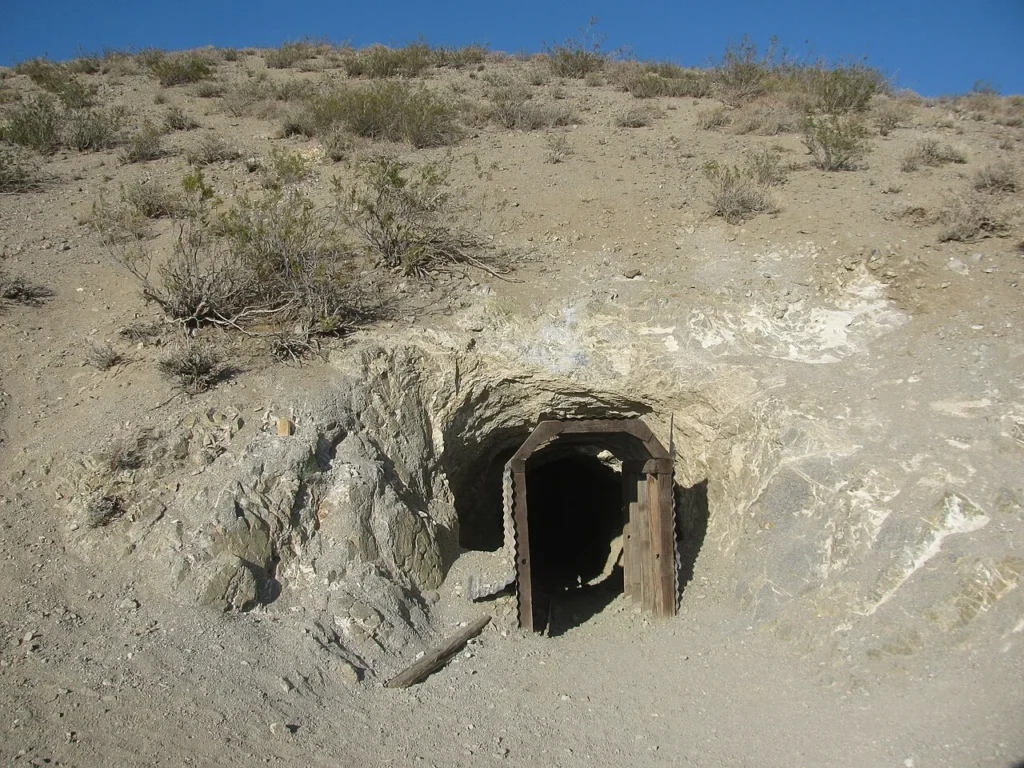
At the time, Schmidt was a prospector with mining claims deep in California’s El Paso Mountains. The terrain between these claims and the nearest railroad was rugged and difficult to cross.
Because of this, transporting ore was a major challenge.
Schmidt came up with an idea: What if, instead of hauling the ore around the mountain, he could transport it directly through it?
What if he dug a tunnel?
So he got to work.
Fourteen years passed. The tunnel was still underway, and the transportation problem was becoming more pressing by the day.
Then, around 1920, while Schmidt was pouring all his time and effort into the tunnel, a new road was built, together with new railroad access, providing an easier route around the mountain.
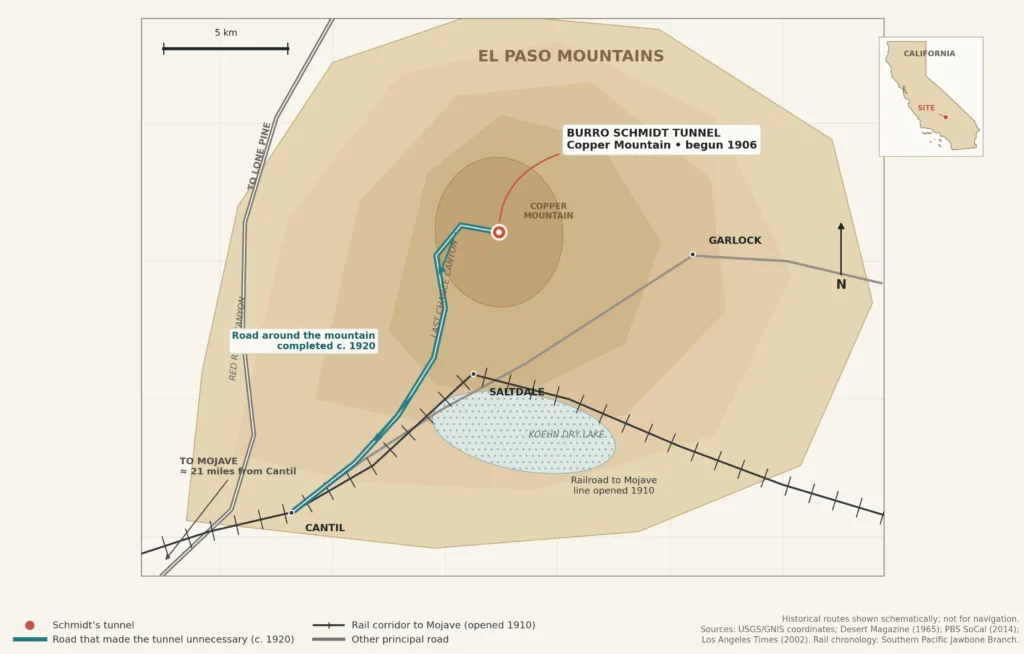
Just like that, the problem was solved. It was time to move on and put the hammer down.
Schmidt said NO.
He continued to dig for another eighteen long years, drilling with hand tools, blasting the granite with dynamite, and pushing the rubble out by hand.
In 1938, at the age of sixty-seven, Schmidt finally broke through the other side and saw his goal through to the end.
After thirty-two long years of struggle, he had created something of extraordinary permanence: a 636-metre tunnel through solid granite, estimated to last 500,000 years.
Not a single load of ore has been carried through it to this day.
And he never explained why he did it, either.
During a recent discussion about this extraordinary feat, someone asks the question that would naturally come to anyone’s mind:
“Did he ever say why?”
The other person answers:
“No. I guess pretty much the day after he finished, he kind of just packed up his stuff and left.”
The Structure Phase
That’s a bit of a weird goal to set for yourself, to spend thirty-two years digging a tunnel that ultimately served no practical purpose, one might argue. But setting any type of goal is a challenge in itself.
One reason goal setting troubles us so much is that we don’t really know why we’re here.
We didn’t ask to be born. So a goal is something that we have to figure out on our own.
It’s an existential challenge, and finding one gets harder and harder as time goes by.
For most of human history, I suppose, we didn’t have to think much about what we had to do. Do you think a hunter-gatherer had to choose between different jobs?!
Of course not.
Their goals were more immediate. They just had to find food, build shelter, protect their group, and just… survive.
But today, with an increasingly fragmented division of labour, we face an enormous number of choices every single day. They overwhelm us. As the philosopher Albert Camus puts it:
“Should I kill myself, or have a cup of coffee?”
With this abundance of choices comes a great deal of pressure.
There are just so many unknowns.
Even after we make a choice, the outcome is never entirely within our control. You could make a perfectly reasonable decision today and still end up with a bad outcome later.
What if we achieve our goals and still fail, as one might argue was the case in William Schmidt’s story?
It’s tempting, but also quite unsettling, to dwell on these questions. But there’s a problem with this whole argument.
It’s built on the assumption that if the goal fails, the entire pursuit was also a failure.
But this is not quite true. And there’s a whole lot of research to back this up.
Pursuing a goal can profoundly change us long before we achieve it. Our personal well-being, for example, is more closely associated with progress towards a goal than with achieving it.
The solution, then, is to make the best decision we can today. Certainty is a luxury we cannot afford.
Having a goal, even a flawed one like the one William Schmidt committed himself to, can provide stability and a sense of direction. And if things go sideways, we can always adjust our course as we go.
In other words, “the beauty is in the attempt”.
As the comedian Jimmy Carr puts it:
“It’s not the pursuit of happiness. It’s the happiness of the pursuit.”
The interface
In practice, this could look like:
Set a time-bound goal:
- The closer the finish line, the easier it is to keep up the motivation and build self-confidence. So instead of setting vague and distant goals like “I want to get fit”, it’s more practical to set goals like “I will exercise three times a week for the next three months”.
Track your progress:
- Tracking the progress helps reduce the ambiguity around goal setting and the stress that comes with it. Make your progress quantifiable.
- For example, if the goal is to exercise three times a week, track the number of workouts or the total number of hours of exercise.
- Over time, this lets you see the patterns that you’d otherwise not notice and also helps to adjust the course moving forward.
Make it concrete:
- Fear of failure holds us back from setting a clear-cut goal.
- It’s much more productive to fail by being bold and specific than to survive by being vague and confusing about what we really want in life.
- For example, if your goal is to complete a marathon, instead of filling your schedule with vague promises like “I will do my best to train,” set a concrete goal: “I will train for one hour, five days a week, for the next 60 days.”