Great artists truly are a rare breed.
More often than not, there comes a point in their careers when they’re forced to sacrifice their creative genius just to feed the market’s appetite for more of the same.
But every once in a while, there comes a rebel who takes on that system and wins.
It is all the more satisfying to witness this.
This week’s newsletter is about one of those rare rebels.
With more than 17 million listeners on Spotify and seven UK Top 20 hits to her name, 23-year-old British singer-songwriter RAYE was already a star by anyone’s standards. But she did not seem to feel even a bit like one on this mild Sunday morning in June 2021 when she sat down in the studio for Channel 4’s Sunday Brunch to promote her new single, “Call on Me”. As the interview turned to her debut album, her smile began to crumble. She looked as if she were trapped in her own mind, as if her dream of becoming a star was well within reach, but for some reason, she couldn’t quite grasp it.
This was a dream she’d held dear for so long. Growing up in a small town called Croydon in west London, Rachel Agatha Keen, the daughter of a Ghanaian-Swiss mother and an English father, had an upbringing as layered as a gospel harmony. From a very young age, she began to give those roots a voice through music. It became her life. The songs of Alicia Keys, Billie Holiday and Jill Scott found their way to her through her father’s CD collection.
One musician she came to admire above all else was the late, great jazz singer and pianist Nina Simone. Rachel was struck by how bravely, honestly and unapologetically Simone expressed herself through her music. She embraced the words on the Nina Simone poster hanging on her bedroom wall — “It’s an artist’s duty to reflect the times.”
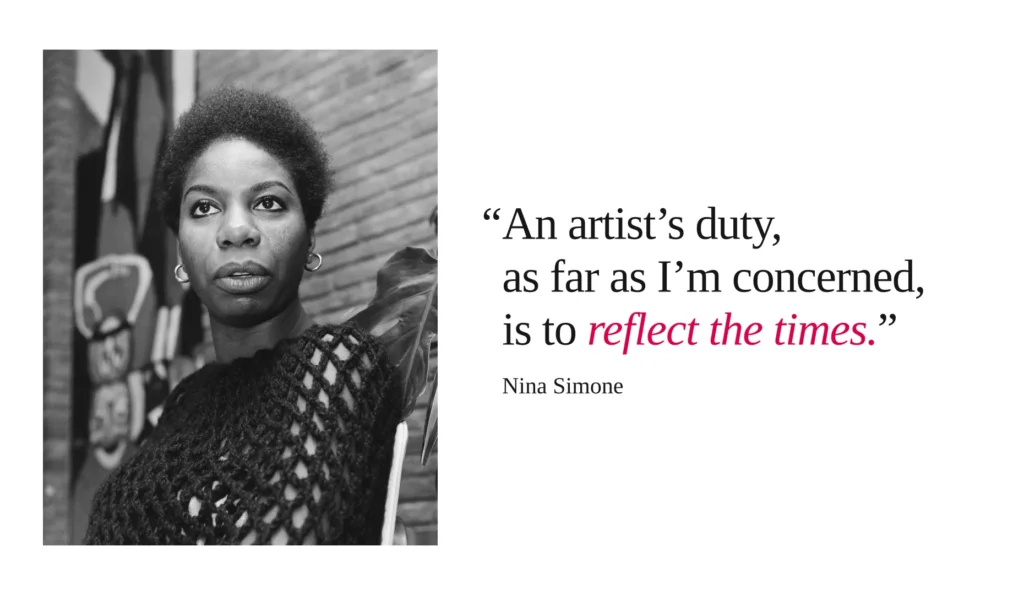
So, a dream was born. A dream to become a musician and “reflect the times” through her own voice. She had the voice to achieve it, too. By the time she was 17, she’d written, recorded and co-produced her own debut album, Welcome to the Winter, including seven tracks, all put together in only 18 months. The news that of a talented teenager, who was mastering the music scene, was quickly passed down to all corners of the industry. The people at record-label giant “Polydor” certainly took notice and signed her to a four-album deal.
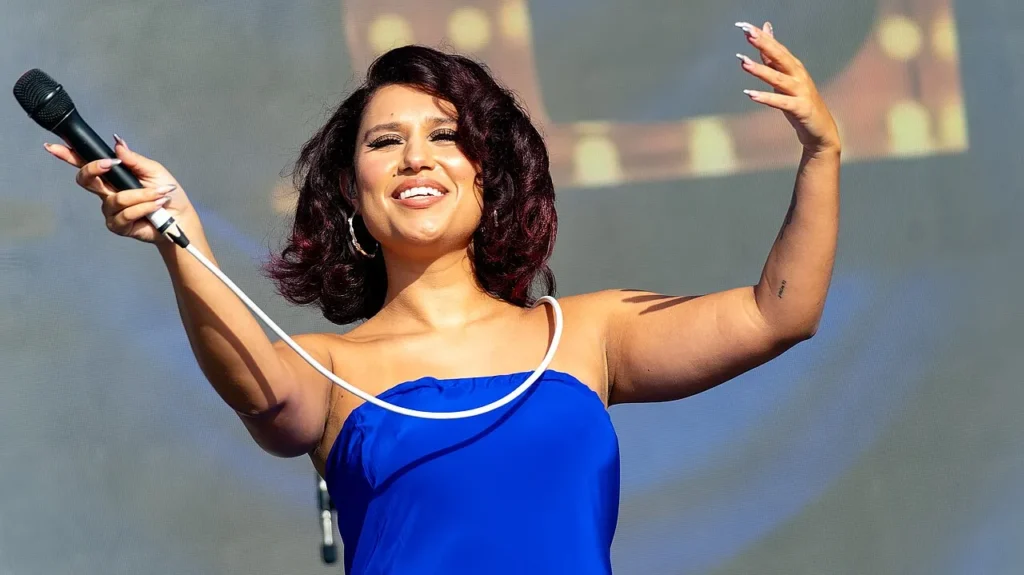
Enter RAYE!
Everything was looking up at this point in her career. The dream of becoming an artist with an untamed voice was finally within reach.
Or so she thought…
Music had always been her way of expressing herself, so it stood to reason that her music would spill beyond the boundaries of a particular genre. “Gospel, soul, jazz, and R&B were what I felt connected to as an artist,” she says, “and what that first album I’d always planned on sounded like.” But the record company told her that the kind of R&B she’d hoped to make wouldn’t sell in the UK.
She somewhat expected this pushback. “There’s a formula,” she later explains in an interview. “You feature on several dance tracks [by other DJs], and then, when you’re in a strong enough position, you can take the names off. You can do it by yourself. That was the strategy.”
So, she started to play along. And it seemed to be going well at first. The label put out some of her R&B and hip-hop material, allowing her to showcase her range to some extent.
But the more she went along with this strategy, the further she seemed to drift away from the music she actually wanted to make. What finally tipped the scales was the success of her dance music track, “You Don’t Know Me,” which quickly climbed to No. 3 on the UK Singles Chart. Great news at first, but this song would soon become a double-edged sword for RAYE’s career. Because now, the label seemed determined to press her into a mould. A mould of “dance music”, at 120 beats per minute, which RAYE had no interest in making a career out of.
“What makes them proud isn’t what makes me proud,” she recalls in an interview.
Her career seemed to be going nowhere. By 2021, seven whole years after signing the four-album deal, RAYE had released none. Instead of establishing herself as a recording artist in her own right, she was being pushed into the role of featured vocalist on other people’s songs, or, as she calls it, a “rent-a-vocal” dance artist.
With this immense pressure weighing on her shoulders, RAYE started to lose her identity altogether. Drugs, alcohol and nights out became her escape. “I can’t do this sober,” she recalls, looking back at this bitter time in her life. Both her mental and physical health started to crumble.
She’d finally hit rock bottom. The dream she set herself by the words on that Nina Simone poster is now completely out of reach. She sits in front of it and breaks down. “I sat there, thinking,” she says, “‘I’m not doing that [reflecting the times] at all’, you know?”

This is one of the biggest hurdles anyone has to clear in pursuit of any kind of creative venture. And it gets harder and more pressing as your career expectations deviate from the norm, which was certainly the case for RAYE.
However, as contradictory as it sounds, what RAYE wanted to achieve and what Polydor wanted her to achieve were pretty much the same: her next single to be a hit. There’s no question about this. The problem is, though, they wanted it to happen for entirely different reasons. RAYE was hoping a hit would buy her the freedom to make the kind of music she’d always wanted to make. But Polydor was hoping for a hit so she’d make more dance tracks, which was exactly the mould she wanted to break out of.
The irony!
But that raises the question, “Why would anyone, especially someone with such unique ambitions as RAYE’s, sign a deal with a company in the first place?”
There are two crucial reasons: (1) money and (2) connections.
In the grand scheme of things, it’s quite hard for one person to break through the noise and establish their creative talent without a powerful hand by their side. There’s a reason why these companies earn billions. They’re useful and, for some artists, even necessary.
The only problem is that a company with a whole roster of artists bases its business model on the average one. RAYE was anything but average.
“I wasn’t the only one who was forced to follow this strategy,” she says. “The difference is that I didn’t want to do that.” The mould built around the average artist did not fit her. The more she tried to squeeze into it, the more harm it did.
So what’s the solution to this? How does one break out of this creative bind?
Having studied the careers of such extraordinary talents for quite some time, I see one path that most of them take, RAYE included.
It is to trust your mission wholeheartedly.
If you’re passionate enough about what you do, and you’re confident enough that your work will strike a chord with people, you are more than capable of cutting out that middleman and just reaching out to your audience directly. The work itself will do all the groundwork for you.
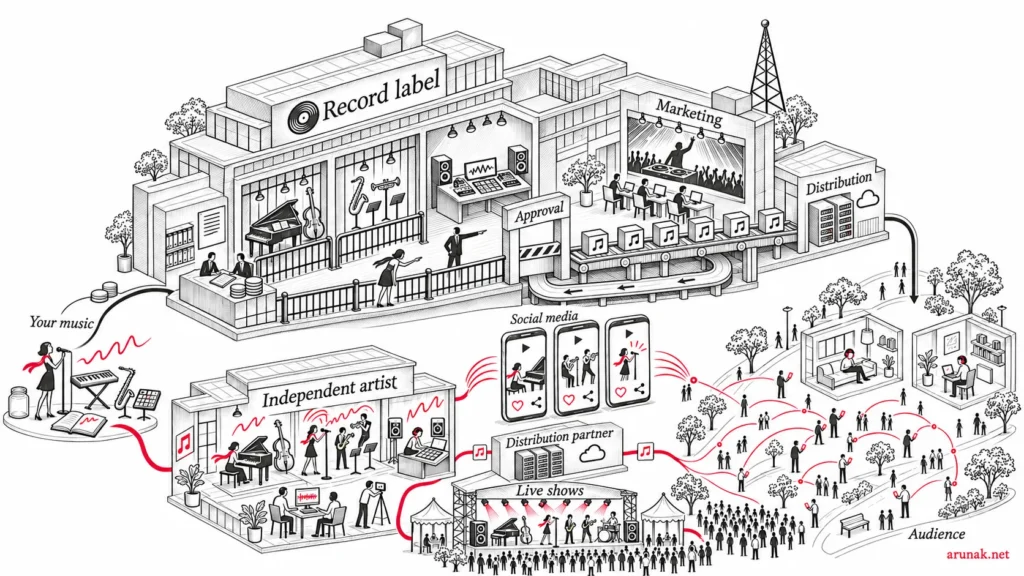
However, this is by no means a guarantee that it’ll be smooth sailing from there. Often, it’s anything but. But, at the very least, you’ll spare yourself the headaches that inevitably come with a mismatched collaboration, one that will hold you back from the success you’re capable of achieving.
If you want to become successful in an unconventional career, you should have the guts to take unconventional routes to achieve it.

Two years after that strained interview on Channel 4, RAYE breaks down in front of the Nina Simone poster and decides to drop the pretence that her career is going even vaguely as planned. So she goes on social media and shatters that illusion for good.
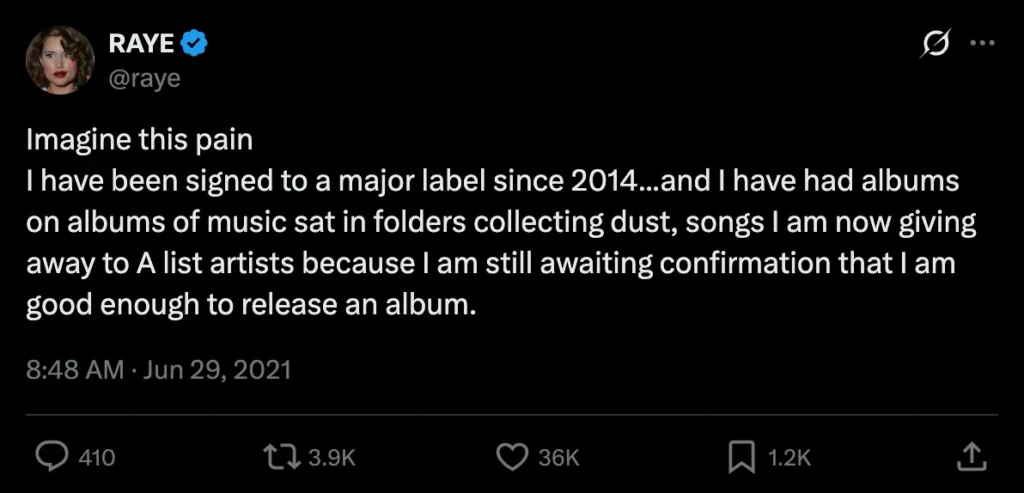
Just under three weeks after posting this viral Twitter thread, RAYE announces that she and Polydor are parting ways.
She’s finally worked up the courage to cut out the middleman and bring her music directly to her audience. “I am not trying to sign anything for a very long time,” she says right after her departure from the label. “I just want to build a fanbase and release my album. My time is coming.”
After seven long years of fighting for her freedom—both personally and professionally—now she finally gets to exercise it. “I’m completely in control. It’s beautiful. I’ll never take creative freedom for granted again,” she said.
The long-lost dream of making brave, honest and unapologetic music has now returned, and it comes through loud and clear in the very first song she puts out as an independent artist—a song called “Hard Out Here.” Addressing the dreaded time at the label, she sings, “Get your pink chubby hands off my mouth.”
But things didn’t get dramatically easier right off the bat. Her workload has become overwhelming. But she embraces it wholeheartedly for the sake of the creative freedom she’s fought so hard to win. “I thought I worked hard before, but yeah, social life? What social life?” she recalls. “But this is what I’ve always wanted, just to be a woman able to say whatever she wants to say, when she wants to say it.”
Both her mental health and her relationship with alcohol slowly begin to turn a corner. So she decides to pour all that pain that is now draining out of her system into a song that runs four minutes and thirty-two seconds.
She calls it “Escapism.”
The first time RAYE makes music without chasing numbers or stats, she gets them all. “Escapism.” quickly becomes a sensation on TikTok and, with that momentum, climbs to No. 1 on the UK Singles Chart in January 2023.
“The beautiful irony,” she laughs, looking back on this moment.
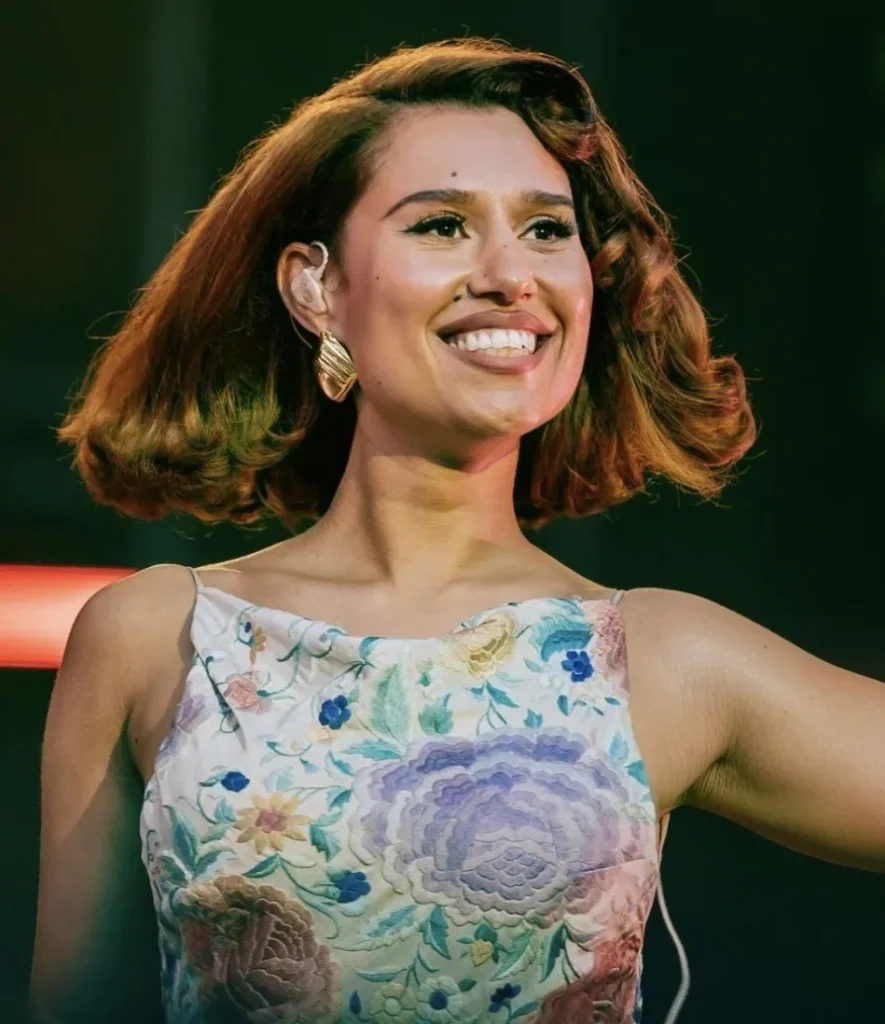
Her career refuses to be anything but brilliant after “Escapism.” In February 2023, RAYE releases her debut album as an independent artist, My 21st Century Blues, a mix of R&B, rap, club music and ballads, and earns a spot on the Vogue 25 power list. And then, she goes on to win a record-breaking six awards in one night at the 2024 BRIT Awards.
In September 2025, she releases the single “WHERE IS MY HUSBAND!”, a brassy, one-of-a-kind pop song that doesn’t fit into any particular genre.
It climbs to No. 1 in the charts and earns her three nominations at the upcoming 2027 Grammys—Record of the Year, Song of the Year and Best Pop Solo Performance—out of 11 total, the most for any artist this year and a tie with Beyoncé for the most by a woman in a single year of all time.
Her time has finally come…