
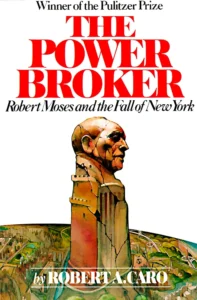
One-line takeaway
Power without humility is just greed in disguise.
What is The Power Broker about?
This is one of those books that needs no introduction. If you searched for it, you already know what it’s about.
That said, if I had to introduce it to somebody, I’d introduce it as not a biography.
“I was never interested in writing biography just to show the life of a great man,” Robert Caro says. “I wanted, with Moses to show how power works.”
And that’s what this book is about: a historical narrative about politics, economics, law, urban planning, and a carefully constructed account of how all these forces converge to produce power.
Robert Moses is one of the clearest embodiments of power for his time, so Caro chooses him as the vantage point to tell this story.
Perfection!
This is Caro’s longest book: an absurdly long, 1,344-page monument.
So, I never really understood Robert Caro’s playful complaints about having to cut some of the chapters…until I finished it.
There’s no fluff, no padding, just really interesting stuff narrated by one of the best journalists of our time.
It’s well worth the time of anyone who wants to understand how power works out in the real world.
Table of Contents
Key Takeaways from The Power Broker
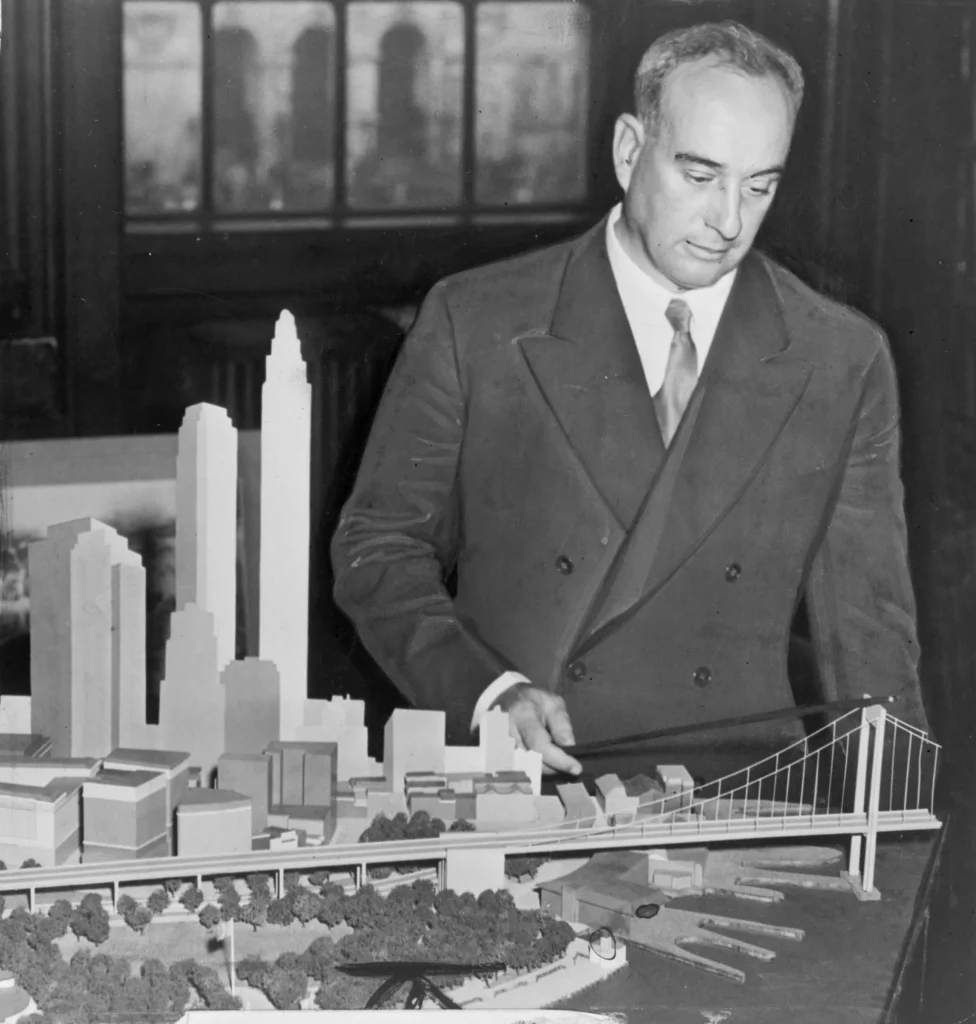
Who was Robert Moses?
Robert Moses was a New York public official and urban planner who became one of the most powerful unelected figures in twentieth-century America. From the 1920s through the 1960s, he reshaped the entire city of New York with parks, bridges, highways, beaches and housing projects. Through all this work, he became one of the most concentrated sources of power of his era.
Moses, the perfectionist
One of the most striking facts about this story is that Moses does not begin as the obvious villain of it. Even Robert Caro didn’t intend to see him that way when he first began researching the book.
Moses, in his youth, is this brilliant, disciplined, and genuinely driven perfectionist, who reads widely and works harder than anybody else around him. He’s a textbook reformer, someone who wants cleaner government. He seems to believe in public service in a way that one tends to admire, and Caro does a great job portraying him as such in the first few hundred pages of the book.
But then, he gets to practice power. And with that, we really get to see the real Moses.
The more I think about it, the clearer it becomes to me that as strong as he is in his intellect, he lacks quite a lot in the morality department. He uses power to just stay in power, with no real regard for what it can actually do for other people.
And he uses his intellect to its fullest to stay in power for more than forty years.
“Getting things done” can become a dangerous moral excuse for “corruption”
As New York City Parks Commissioner, Robert Moses was, in many ways, exactly the kind of person the job seemed to need. His work ethic, the ambition, the energy, and the charisma are just phenomenal.
And the scale of what he built for New York is monumental. When Moses became Park Commissioner in 1934, New York City had 119 playgrounds. By 1960, it had 777.
In a political arena where people usually care more about appearing to build things than actually building them, Moses was the real deal.
He got things done.
But with the true instinct of journalism, Caro breaks through this first layer of admiration to discover something else, something problematic: Moses’s lack of moral concern for the things he built.
Moses built things while avoiding the most important questions:
- Done for whom?
- Done at whose expense?
- Done by what means?
- Done with whose consent?
He just wanted to build, for the sake of building.
Most of Robert Moses’ neighborhood playgrounds had, in other words, been built in the neighborhoods that needed playgrounds least. Few of the playgrounds had been built in the neighborhoods that needed playgrounds most (p. 510).
This has been one of the core themes of the entire book: accomplishment without accountability can slowly become its own form of corruption.
The promise of a good cause to promote merely selfish agendas
Something Moses understood very early in his career is that being the Parks Commissioner gave him the unique advantage of seeming to be the perfect public servant.
Because no matter what his intentions were, at the end of the day, he was fighting for parks. And parks are built for people.
So his opposition, in people’s minds, could be made to look selfish, greedy, and against the public good.
This lesson Robert Moses would often recite to associates. He would put it this way: As long as you’re fighting for parks, you can be sure of having public opinion on your side. And as long as you have public opinion on your side, you’re safe. “As long as you’re on the side of parks, you’re on the side of the angels. You can’t lose.” (p. 218).
Hospitality has always been a potent political weapon. Moses used it like a master (p. 826).
Moses, being as smart as he was, fully understood this moral shield and used it for his own advantage.
And this was one of the most eye-opening realizations in the whole book: power is usually strongly attached to some form of public service, so nobody can easily criticize the methods behind it.
This is not limited to parks. It could also be any kind of progress that is tied to public wellbeing: housing developments, safety projects, road access, or the promise of a better future.
When a person is seen as the champion of one of these campaigns, the public becomes way more interested in the outcome than in how they are going to get there, and the damage done along the way.
This was Moses’ genius. He kept the attention of the public away from how he went about building stuff, which was where the real problem was.
Seeing all this, it’s easy to criticize the public. But that wouldn’t be a fair assessment. It’s quite straightforward that people wanted parks, road access, and beaches.
And Moses delivered. This is why he was able to remain in power for so long.
So the problem wasn’t that all the things he built for the public were fake; it’s that those things became just a front, a decoy that covered all the economic, and political damage happening behind the curtains.
The “public” and the “people”
One of the recurring themes I came across while reading the book was that Moses loved the public, but couldn’t care less about the individual.
His good public self lived in the abstract. All his plans for parks, beaches, roads, and many other public projects sounded wonderful for “the people” on paper.
But he could not care less about a farmer whose field was cut in half for road construction, even when moving the road a little farther would have saved the most cultivable part of his land. At the same time, Moses had moved road plans by miles when it benefited people who might be useful to him later.
He loves the public, but not as people. The public is just the public. It’s a great amorphous mass to him; it needs to be bathed, it needs to be aired, it needs recreation, but not for personal reasons—just to make it a better public.” (p. 318).
He could not care less about people’s routines, their attachments to religion, schools, or neighborhoods, even when the construction plans could have been changed to make room for these things.
This is where his genius seems to truly fail him.
Instead of building a city around people, he was trying to build a city around an idea of “the public.”
Moses’ greatest strength turned out to be his Achilles’ heel
This book is obviously written as a critical account of Moses. Even the title reads: Robert Moses and the Fall of New York.
And based on the events of the book, it’s very clear to me that he played a central role in that fall.
But I could not help but admire Moses’ work ethic.
It’s intriguing. He was, no doubt, the best man for the job. He was quick to make decisions, and quite effective in making them. He trusted himself, and would not hesitate to act.
“He worked all of us hard,” one of them recalls. “But he worked himself harder. He was at the Bureau when you got in in the morning, and he was still there when you left at night. He’d lose his temper, but it was silly to argue with him anyway, because you knew darn well that he had looked the point up before he talked to you and knew it better than you did.” (p. 74).
He had an immense energy and almost superhuman capacity for the work he was given.
But this very strength later became the source of his downfall.
The problem was that he was so focused on the work that he completely forgot who he was doing the work for.
He just kept going, building stuff that would make the city “look good,” not necessarily taking into account how people would actually live in it.
He did not listen to the public, experts, or even the mayors or governors.
But if in the shaping of New York Robert Moses was an elemental force, he was also a blind force: blind and deaf, blind and deaf to reason, to argument, to new ideas, to any ideas except his own (p. 830).
Bob Moses has climbed so high on his own ego, has become so hidebound in his own arbitrariness, that he has removed himself almost entirely from reality and has insulated himself within his own individuality (p. 485).
Eventually, what should have been a public feedback loop, involving millions of dollars and millions of lives, became a private project.
Seeing how this unfolds, it becomes very clear that intelligence, work ethic, vision, and even public-spirited ambition are not enough to build something worthwhile and lasting unless they are tempered with empathy, restraint, and accountability.
The quintessential lesson of The Power Broker
By far, the most subtle and somewhat elusive takeaway from The Power Broker that I came away with is this: power reveals, more than it corrupts.
The more power someone gets, the easier it becomes for their true self to surface.
Throughout this very long book, Robert Caro seems to return to this point again and again. Power does not necessarily make people evil; it just makes it so much easier for someone to become themselves.
In that sense, this book is a warning against worshipping competence without asking what it is really being used for.
How The Power Broker changed the way I think
Power without humility is just greed in disguise.
What is the best reading schedule for The Power Broker?
Everybody has their own pace and rhythm for reading a nonfiction book.
Over the years, mine has changed quite a bit. Most of the rules have slowly fallen away, and today, I just follow one rule:
Read 50 pages a day, or 10% of the book, whichever comes first.
With The Power Broker, which is 1,344 pages, 50 pages obviously comes first. With this pace, I was able to finish the book well within a month, even with a couple of days of not reading, or reading less than 50 pages.
The word count of a page varies from book to book, and The Power Broker falls more on the dense side, so it took me about 1.5 hours to read 50 pages.
Altogether, that comes to about 40 hours of reading.
This would not be the best reading schedule for someone who does not want to allocate that much time per day to reading. There are suggested reading schedules that span months, or even a year.
These are all great and effective reading schedules, but under one very important condition.
You have to be consistent.
With a book this long, and with this many moving parts, it’s quite easy to lose your place if you read it inconsistently.
There are also podcasts that help you read along. One that I’ve found useful is The 99% Invisible Breakdown of The Power Broker, where Roman Mars and Elliott Kalan read through the book chapter by chapter. They also interviewed Caro in episode 12, near the end of the series.
Best quotes and passages from The Power Broker
But power is not an instrument that its possessor can use with impunity. It is a drug that creates in the user a need for larger and larger dosages. And Moses was a user (p. 19).
The purpose of a park, Moses had been telling his designers for years, wasn’t to overawe or impress; it was to encourage the having of a good time (p. 385).
These were roads like no other roads in history, for these were roads through a city (p. 837).
Should you read The Power Broker?
Read this if you:
- want to understand how political power is built, protected, and exercised over decades.
- are curious about how cities are shaped by decisions most people are unaware of.
- are willing to, and comfortable with, spending time with a long, dense book.
- want to understand how one unelected figure, with zero public votes, could reshape the political and economic landscape of New York State.