

Risk-averse is one of those terms we like to throw around as though it is some kind of personality trait.
- Someone who wants to start a business but is too cautious to leave their day job: risk-averse.
- Someone who keeps their money in a savings account instead of investing it: risk-averse.
- Or someone who takes a month to make a decision that another person would make in three days: risk-averse.
But being risk-averse is a little more precise than simply being “too scared to take a chance.” In some situations, it can even be a serious advantage.
So, understanding what it really means, and how it shows up in practice, gives us a real advantage when thinking about any decision that involves uncertainty, from trying something new in everyday life to making a major change in our career, finances, or relationships.
That is what this article is about.
Table of Contents
What does risk-averse mean?
In simple language, a risk-averse person is someone who prefers to stay in the “known” as much as possible. They prefer safer choices and try to avoid unnecessary risks.
More precisely, economists describe a risk-averse person as someone who chooses a certain outcome over an uncertain one, even when the uncertain option offers a higher average payoff.
There are many ways this plays out in everyday life. Imagine, for example, that you are given two options for a small reward at work:
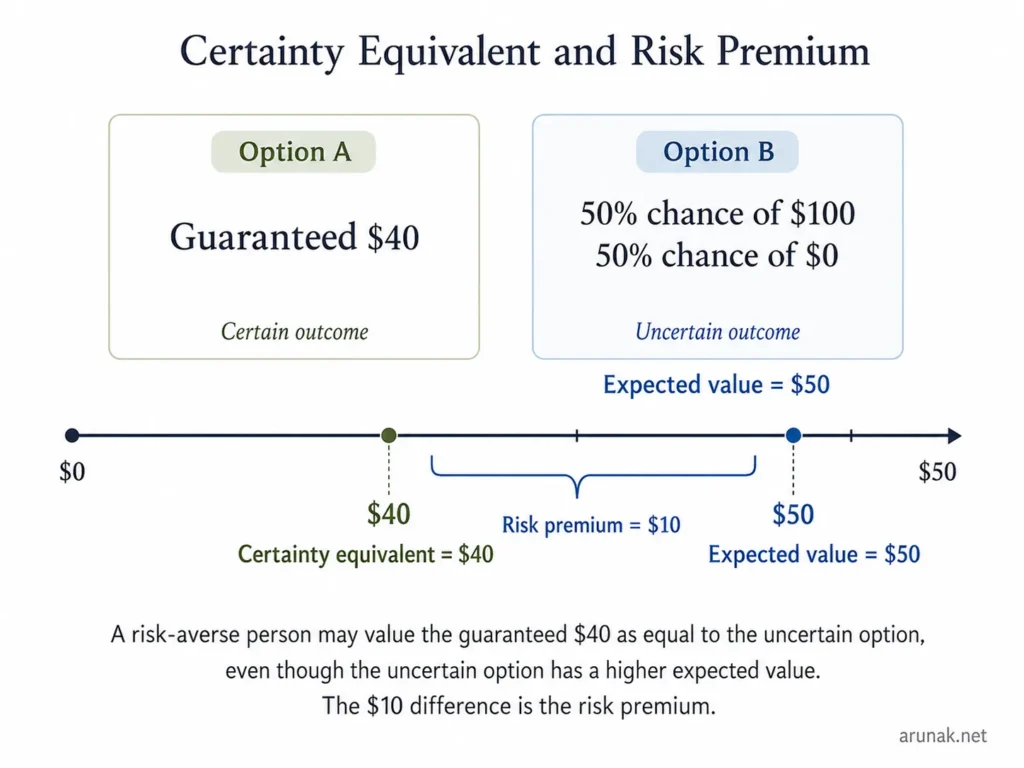
- Option A: Receive a guaranteed $40.
- Option B: Have a 50% chance of receiving $100 and a 50% chance of receiving nothing.
The expected value of Option B is $50, which is $10 more than the guaranteed amount. But if you are risk-averse, the certainty of receiving $40 may be worth more to you than the possibility of receiving $100.
In that case, you are giving up $10 in expected value in exchange for certainty.
Economists describe this using the concepts of the certainty equivalent and the risk premium. The certainty equivalent is the guaranteed amount you consider equal in value to the uncertain option. The risk premium is the difference between that amount and the option’s expected value.
This gives us a clearer picture of what risk aversion really means.
A risk-averse person does not necessarily refuse every uncertain opportunity; they simply want more assurance, information, or control before accepting one.
Being risk-averse does not mean avoiding every risk
So, being risk-averse does not automatically mean being someone who always stays away from risk.
In fact, if you think about it, you cannot really make any meaningful decision without accepting some degree of uncertainty.
- Changing careers could improve your life, but there is always a possibility that you will not like the new workplace.
- Starting a business could give you more freedom, but it may also fail after a couple of years.
- Even staying in the same job carries a risk: the risk that nothing changes while everything around you does.
It’s just that a risk-averse person usually has a higher threshold before they are willing to act on a risky venture.
- They might still change careers, but only after building six months of savings.
- They might start a business, but begin it as a side hustle and spend years testing it before turning it into full-time work.
- They might invest, but choose a diversified fund instead of betting everything they have on one company.
This is why many everyday examples of risk aversion involve controlling risk rather than avoiding it completely.
Some common examples include:
- buying insurance;
- choosing a fixed-rate mortgage;
- remaining loyal to a familiar brand even when a cheaper or potentially better alternative exists;
- preferring a stable salary over a less predictable but potentially higher income.
In other words, risk-averse people want risk to be bounded by a reasonable amount of certainty.
Risk aversion is not one fixed personality type
And being risk-averse does not necessarily mean that risk aversion is a fixed personality trait.
People are rarely equally cautious in every part of life.
- You might be the kind of person who saves every dollar you can but becomes adventurous when it comes to travel.
- You might be fairly comfortable disagreeing with other people but overly cautious about changing careers.
- Or you might be willing to climb a thousand-foot rock face without a rope but avoid parties like the plague.
A recent systematic review published in Nature Human Behaviour examined 358 measures of risk preference across 579,114 people. It found substantial variation across different domains, age groups, types of behaviour, and even the ways risk preference was measured. The different measures also showed relatively little agreement with one another.
So, although there may be a general tendency underneath our choices, we should be careful about treating risk aversion as one fixed trait.
Instead of simply labelling yourself a “risk-averse person” when you are on the fence about a decision, it’s more productive to ask:
Where am I risk-averse, and what is it about this particular risk that makes me so uncomfortable?
Is being risk-averse bad?
Now comes the most common question of all: is being risk-averse a bad thing?
No. At least, not necessarily.
Being risk-averse is sometimes perfectly sensible, especially when the downside of a decision would be difficult to recover from.
Suppose two people are considering leaving their jobs.
One has substantial savings, few financial commitments, and another source of income. The other has no emergency fund and supports a family.
Let us say they do the same job, have the same qualifications, and earn the same salary.
From an outsider’s perspective, it may seem as though they are in the same boat and would therefore take on the same amount of risk by leaving their jobs.
But they are in completely different positions.
Does that mean it would never be sensible for the second person to leave?
Of course not.
But risk cannot be judged by looking at the decision alone. We also have to consider how well each person could absorb the possible downside and recover from it.
In this example, a failed decision would hurt the second person far more.
So, being more risk-averse in a situation like this may simply be a reasonable response to having less room for error.
Risk aversion can be especially sensible when:
- the possible loss outweighs the likely gain;
- the decision would be difficult or impossible to reverse;
- you do not have enough information to make a reasonably informed choice;
- recovering from the possible loss would take a long time.
When can risk aversion hold us back from making the right decision?
On the other side, there are situations where being overly risk-averse can hold us back from making the best possible decision.
There are many day-to-day examples:
- applying for a job that seems like a stretch but is still within reach;
- publishing an imperfect piece of writing;
- asking for a raise;
- trying a small side project;
- speaking with a stranger.
There is some risk attached to all of them: the application may be rejected, the writing may not receive the response we hoped for, or the stranger may not be interested in talking to us.
What holds us back from making a move here is a subtle blind spot.
We know for sure what will happen if we do none of these things: nothing.
But it’s really hard to envision what might happen if we take the chance: a job application could lead to an interview, an imperfect article could lead to a better one later, or a small side project could open up an opportunity we did not see in the first place.
The only way to find out is to act, provided that the possible downside remains within the limits of what we can absorb and recover from.
On the other hand, avoiding these small risks can also create its own kind of risk: stagnation.
After years of turning away from uncertain opportunities, we may eventually realize that our lives have become too constrained by the need to “feel safe” all the time. And by then, what once seemed like protection may have slowly become the greatest threat to our growth.
In that sense, taking small, calculated risks can make us better prepared for the future than trying to avoid risk altogether.
Frequently asked questions
Are risk aversion and loss aversion the same thing?
These two ideas are closely related, but they describe different things.
Risk aversion is a preference for a more certain outcome over a less certain one.
Loss aversion, on the other hand, is the tendency to experience a loss as more significant than a comparable gain.
They can sometimes lead someone to make the same decision, but they do not always work together.
A loss-averse person may even take a larger risk than they otherwise would if doing so gives them a chance to avoid a definite loss. A risk-averse person, by contrast, would generally prefer the more certain outcome.
For a more detailed explanation, read my comparison post: Risk Aversion vs. Loss Aversion.
What is the difference between risk-averse and risk-adverse?
Averse refers to reluctance or opposition.
Adverse generally describes something harmful or unfavourable.
You can be averse to risk, while a decision may still have adverse consequences.
The bottom line
A risk-averse person is likely to place more weight on certainty when making a decision.
But that does not mean they refuse every kind of risk. Nor does risk aversion tell us everything about how someone makes decisions in life. The amount of risk they are willing to accept can change considerably from one situation to another.
Someone can be risk-averse in one area and quite willing to take chances in another. It all depends on the circumstances, the possible downside, and how easily they could recover if things went wrong.
So, the important task is to understand the risk in front of you rather than rejecting every uncertain opportunity or accepting the safest option that is handed to you.
To explore the other end of the spectrum, see what the opposite of risk-averse really means.
