
Index fund investing is one of those things that almost sounds too good to be true.
But it works. It makes money for us when we’re not even looking. For context, if you invested just $10 in the S&P 500 at the beginning of 1957 and reinvested the dividends, by the end of 2025, it would have grown to roughly $10,400.
As John C. Bogle, founder of Vanguard, puts it,
The magic of compounding is little short of a miracle. Simply put, thanks to the growth, productivity, resourcefulness, and innovation of our corporations, capitalism creates wealth, a positive-sum game for its owners. Investing in equities for the long term has been a winner’s game.
All we have to do is put our money in the bank and just wait for time to do the rest. Sounds amazing.
But it’s not quite that simple. After reading several books on investing, I started to realize that the very thing that makes investing so powerful is also capable of making it deceptive. The culprit here is time.
Investing doesn’t turn $1,000 into $10,000 next week, or even next month. Nothing much changes in your investment account in a week or two. It takes time.
These long time horizons create a blind spot. And what’s hiding in that blind spot, the thing we should really be paying attention to, is arithmetic. Or, in investing terms: costs.
Compounding goes both ways. A small amount of money can snowball into a huge sum over time. But the same is true for costs.
So the investor who gets the most out of compounding is not just the one who invests, but the one who manages to cut all the avoidable costs.
Here’s an example of how this shows up in practice.
Say you start with $10,000, then add $500 every month for 30 years into your portfolio, and the investments return 7% a year before fees. To keep this simple, let’s assume the only difference between the two funds is their annual cost.
With a 0.2% annual cost, your effective return would be roughly 6.8%. After 30 years, your portfolio would grow to about:
$662,916
With a 1% annual cost, your effective return would be roughly 6%, leaving you with about:
$562,483
In both cases, the amount contributed was exactly the same: $190,000 over those 30 years.
But the difference in fees leaves you with about $100,000 less in the higher-cost fund.
Big difference!
“Time heals all wounds” is not an adage that applies to the field of investing.
Books Behind This Article
Click on any of the books below to read my full review.
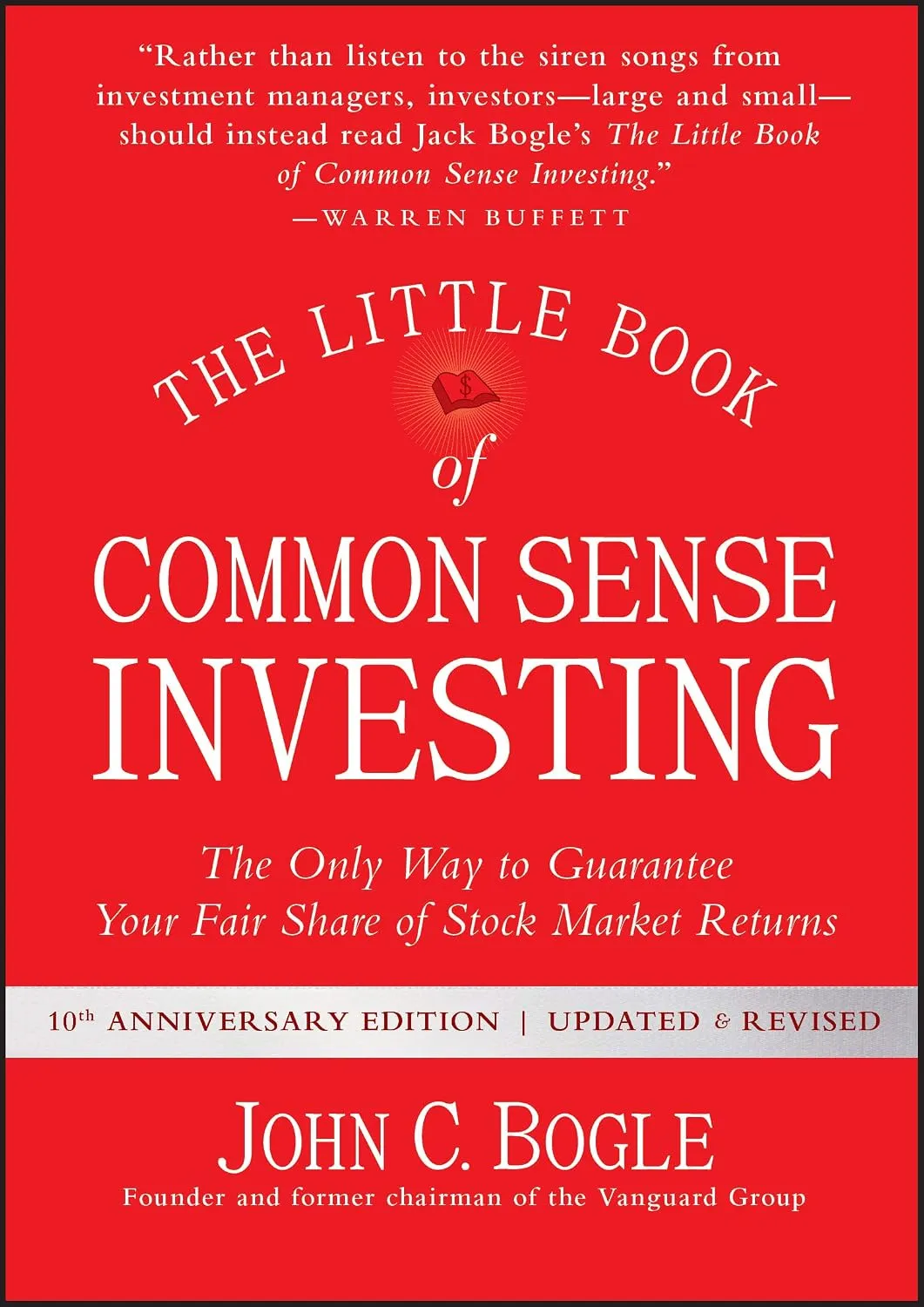

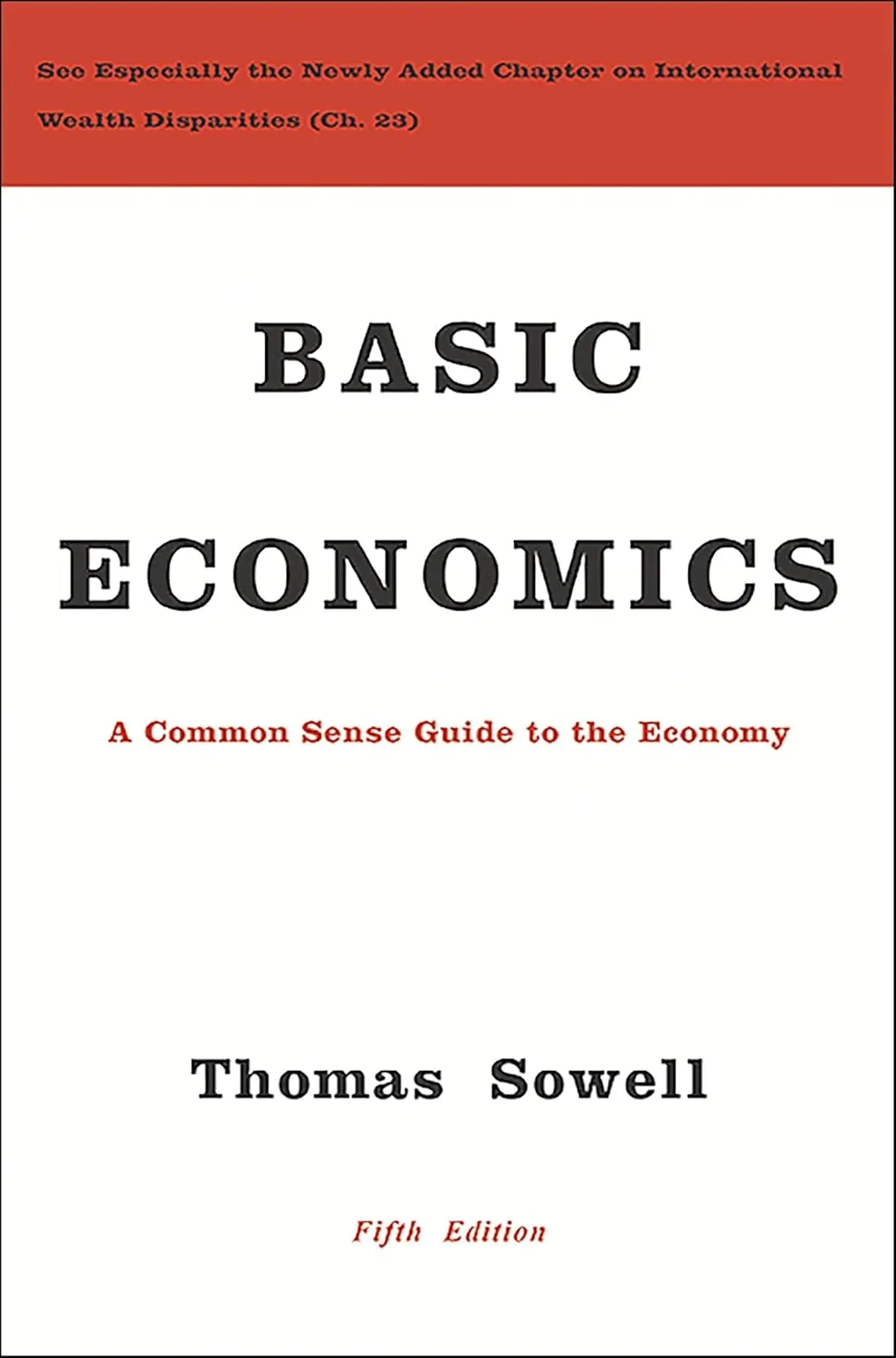
So the takeaway is clear: the most profitable portfolio is often the one that keeps costs as low as possible. But how low is low-cost?
One of the numbers to look for is the MER, or management expense ratio. It’s the fund’s management fee added to its operating expenses, expressed as a percentage of the fund’s assets. In the U.S., this is more commonly expressed as an expense ratio.
A rough benchmark for what makes an index fund a low-cost index fund is an MER below 0.2%, or around this value.
With that question settled, another one takes the stage: “What low-cost index fund, or funds, should I choose?”
The short answer is this: any low-cost index fund that is well diversified.
Well diversified means that the shares are spread across a huge number of companies. Ideally, the shares should also be spread across different industries, different company sizes (emerging markets and well-established ones), and different regions.
For someone investing through U.S.-listed ETFs, a few examples are:
- VTI, Vanguard Total Stock Market ETF, which tracks about 80% of the U.S. stock market. Its expense ratio is 0.03% as of April 2026.
- ITOT, iShares Core S&P Total U.S. Stock Market ETF, another U.S. market fund, with an expense ratio of 0.03% as of August 2026.
- VT, Vanguard Total World Stock ETF, which goes a step further and diversifies its investments across global stock markets. Its expense ratio is 0.06% as of February 2026.
For someone in Canada, which I’m more interested in, there are also many options to choose from:
- VEQT, Vanguard All-Equity ETF Portfolio. Its latest published MER is 0.22%, although as advertised, Vanguard cut its management fee to 0.17% in November 2025.
- XEQT, iShares Core Equity ETF Portfolio, with an MER of 0.20% as of August 2026.
- ZEQT, BMO All-Equity ETF, with an MER of 0.18% as of August 2026.
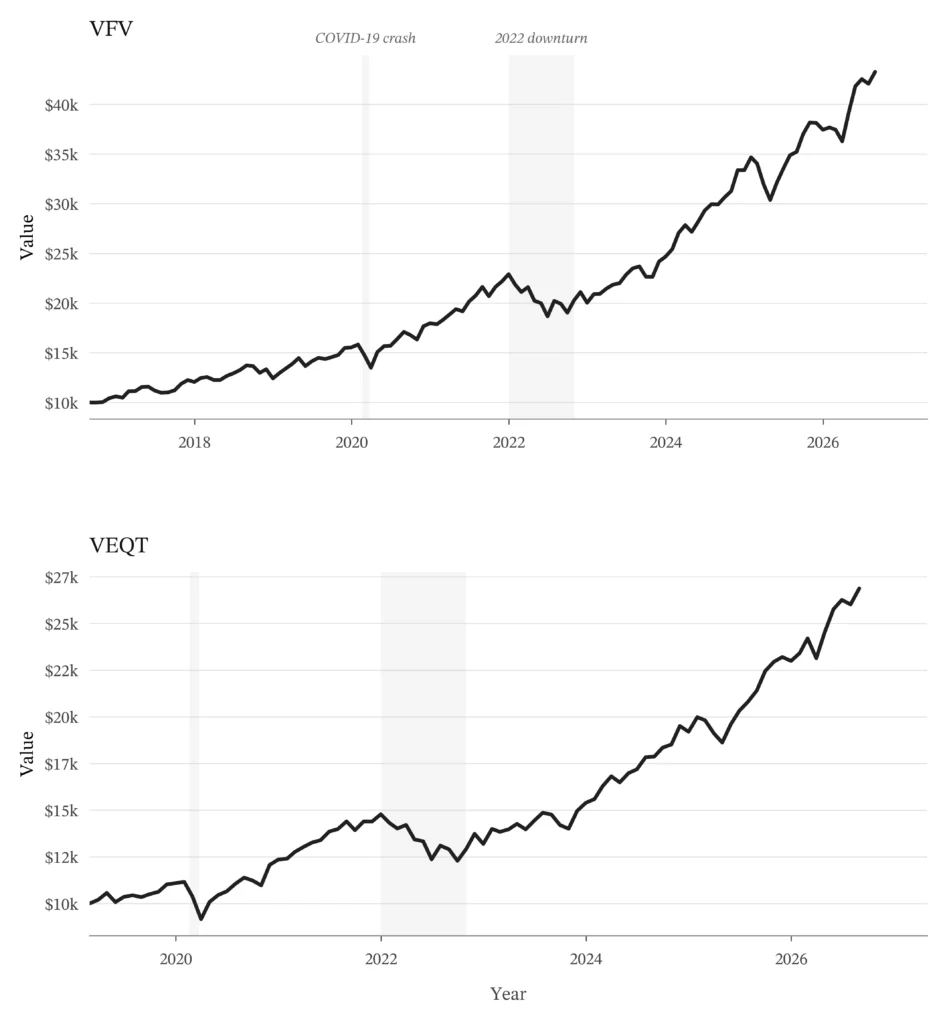
yfinance Python library and sampled at monthly intervals. No additional contributions are assumed. Figure created by the author.That said, there’s nothing wrong with buying a fund or stock that trades in a foreign currency. But if, say, you have Canadian dollars and buy something listed in U.S. dollars, it’s important to pay attention to the additional cost incurred during the currency conversion.
As mentioned before, it all comes back to arithmetic. Gross market return minus the costs of investing is what ultimately ends up in our pockets.
