Snapshot
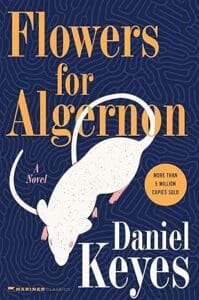
After an experiment that had been tested only on a mouse named Algernon, Charlie Gordon, a man born with an unusually low IQ, increases his intelligence to unprecedented levels.
What follows is truly heartbreaking…
An Ancient Truth
The fundamental premise of this book has been around for millions of years. It takes different forms, and we’ve put it into words using familiar phrases: “As you sow, you shall reap.” Scientists call it “cause and effect.” Buddhists call it “karma.”
Or, in the words of the protagonist,
“ARTIFICIALLY-INDUCED INTELLIGENCE DETERIORATES AT A RATE OF TIME DIRECTLY PROPORTIONAL TO THE QUANTITY OF THE INCREASE.”
page 255
A Human Touch to a Fundamental Truth
Millions of readers have been drawn into this book because the plot gives that premise a human touch.
It’s rare to find an exceptionally good book written in the first person these days. That point of view isn’t easy for a writer to pull off, especially when you’re trying to deliver a deeper message while writing in plain language, sometimes even broken language, to bring about the main character’s mentality.
I believe this book is an exception. It competes with some of the most successful books in the same genre, like “The Catcher in the Rye.”
Charlie’s Emotional Roller Coaster
It invites you to ride an emotional roller coaster with a unique protagonist. The story fluctuates so dramatically that at some point, I was convinced the protagonist and antagonist were the same character.
At the beginning of the story, however, Charlie is kind and humane despite all the hardships he faces.
“Prof Nemur says if it werks good and its perminent they will make other pepul like me smart also. Mabye pepul all over the werld. And he said that meens Im doing somthing grate for sience and Ill be famus and my name will go down in the books. I dont care so much about bee-ing famus. I just want to be smart like other pepul so I can have lots of frends who like me.”
page 13
The Transformation
Even after his intelligence increases, Charlie acknowledges he’s still the same person. He wants to stand up for the “Old Charlies” of the world.
But then something shifts. All this humanity seems to end. He starts referring to the Old Charlie in the third person, as if he wants to see the Old Charlie as a separate individual.
“It didn’t upset me, although I would have expected it to. Somehow, getting drunk had momentarily broken down the conscious barriers that kept the old Charlie Gordon hidden deep in my mind. As I suspected all along, he was not really gone. Nothing in our minds is ever really gone. The operation had covered him over with a veneer of education and culture, but emotionally he was there—watching and waiting.”
page 195
Intelligence vs. Humanity
It is at the end of the book that the book delivers its most meaningful message, which is that intelligence alone isn’t worth much if it is not accompanied and balanced by humanity.
“That’s not completely true,” I said softly. “But I’ve learned that intelligence alone doesn’t mean a damned thing. Here in your university, intelligence, education, knowledge, have all become great idols. But I know now there’s one thing you’ve all overlooked: intelligence and education that hasn’t been tempered by human affection isn’t worth a damn.”
page 249
It all Comes Full Circle
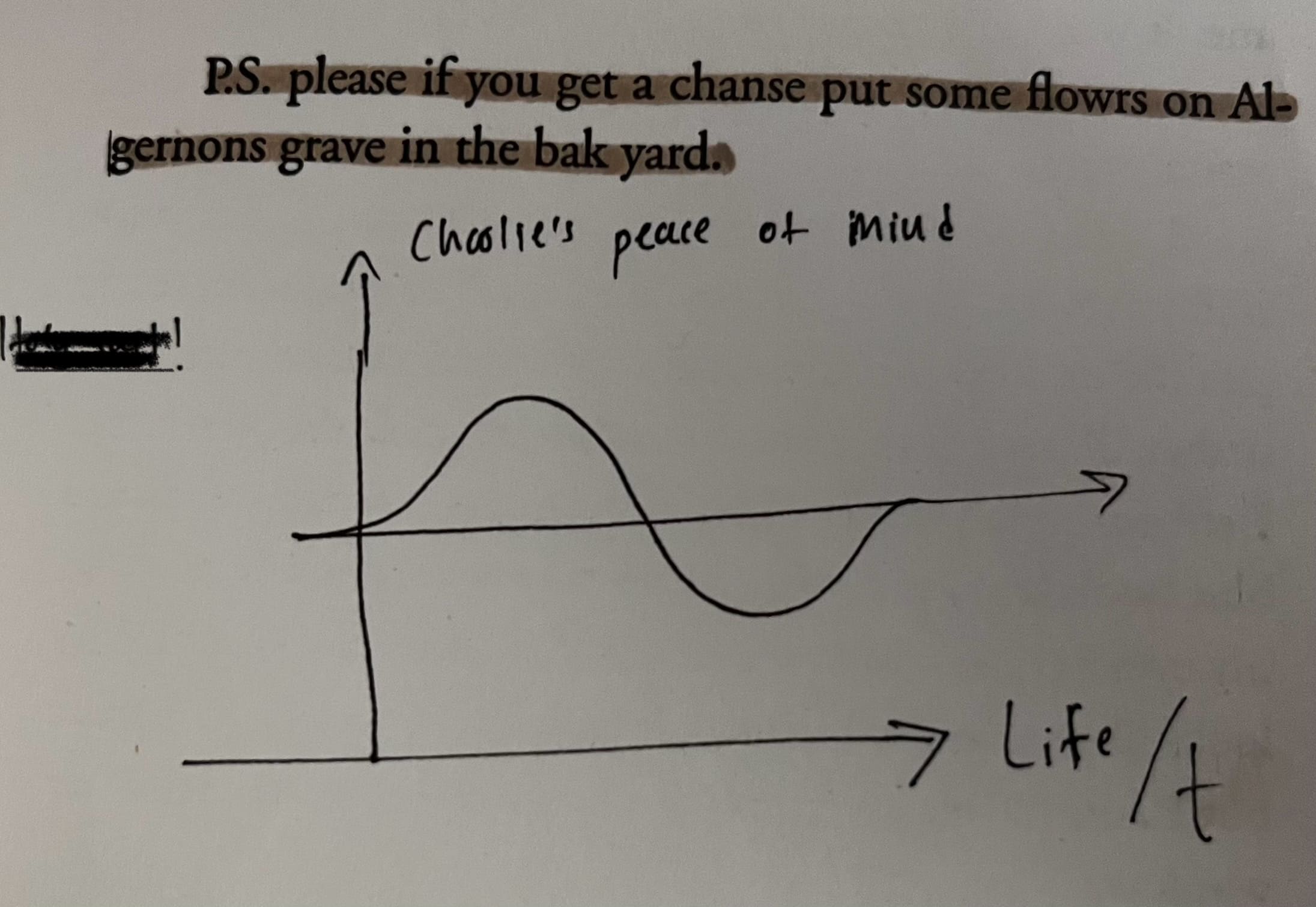
But gradually, his intelligence fades. He finds himself regressing, slipping back to where he started, to the point where he can’t put up a couple of sentences together, like in the old days.
It all comes full circle.
In the end, both Algernon and Charlie must confront the most fundamental and undeniable truth of the universe. At least Charlie’s mind has been restored after going through that roller coaster of a mental journey.
“Im glad I got a second chanse in life like you said to be smart because I lerned alot of things that I never even new were in this werld and Im grateful I saw it all even for a littel bit.”
“P.S. please if you get a chanse put some flowrs on Algernons grave in the bak yard.”
page 311
At the end of the day, it was just a ‘pulse’, a small disturbance in Charlies’ life, but the whole world around him was changed and influenced by it.