Side hustles are a dime a dozen nowadays. Everybody’s doing something on the side.
But plenty never get off the ground, even when the ideas behind them are fundamentally sound.
Why?
How to stay motivated through a side project, hold yourself accountable, and bring it to fruition: that’s what this week’s newsletter is about.
The Story Phase: An ambitious pursuit
On an early summer morning in June 1896, Henry Ford, a 32-year-old engineer, stands beside a strange-looking automobile on four bicycle-like wheels. He’s spent months burning the midnight oil to put it all together. He named it the “Quadricycle.” And today, it’s finally ready to hit the road.
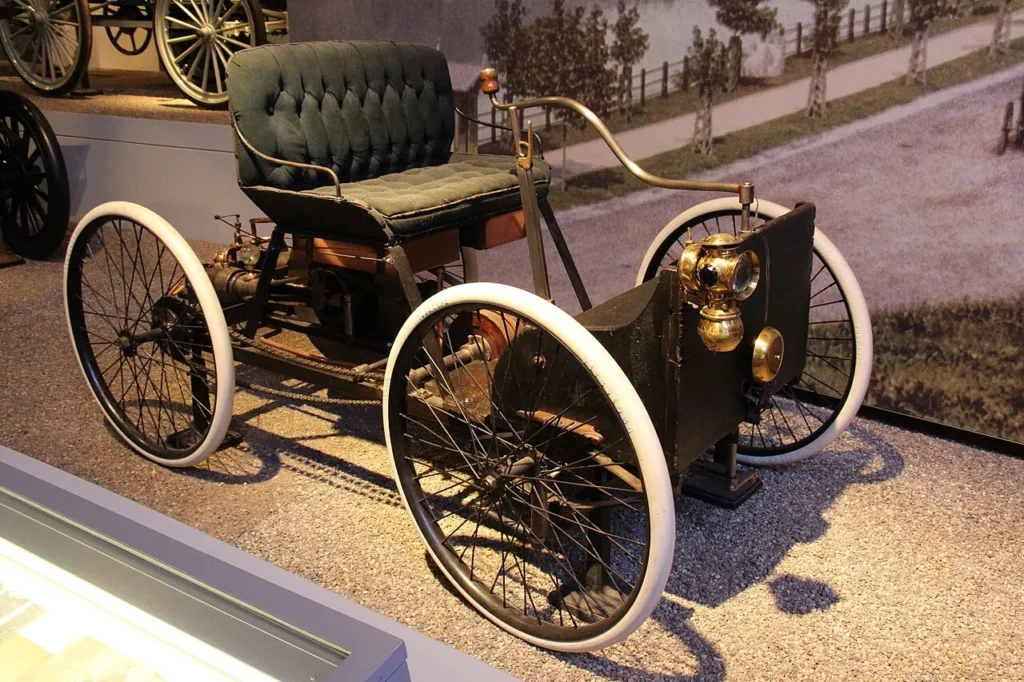
But Ford realized pretty much immediately that this is going to be a long day. There were obstacles from the get-go, one of which came even before he rolled it down to the road.
Through all that work he put himself through designing the Quadricycle, it slipped his mind that his garage doors are too small to pass it through. Realizing this, he grabs an axe and knocks some bricks over on both sides of the door to make way.1
As if this was enough trouble for the day, the engine broke down a couple miles into the test drive. Obstacles after obstacles after obstacles…
Regardless, many historians consider this day as the beginning of Ford’s ascent as an innovator that would one day make him a pioneer of America’s transportation industry. But it’s pretty clear that Henry Ford himself may have not felt even a tiny bit of this glory that day. It’s interesting that the appreciation of commitment often arrives at the eleventh hour.
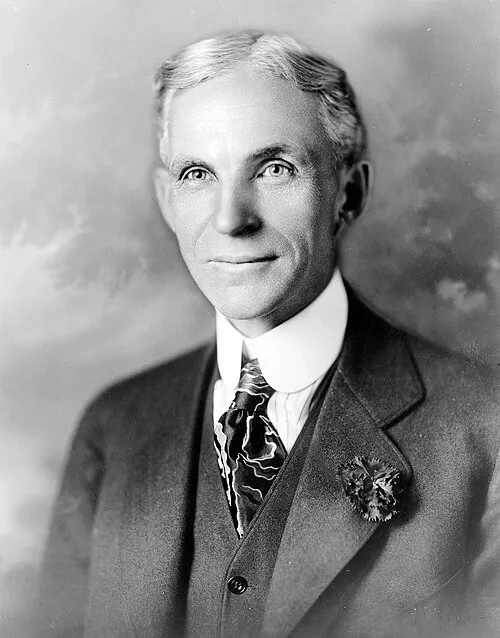
Even more interestingly, Ford’s commitment to building the Quadricycle was entirely self-imposed. Nobody was holding his feet to the fire to do this.
At 29 years of age, 3 years prior to the test run of the Quadricycle, he was elected chief engineer at the Edison Illuminating Company in Detroit. He earned around 125 dollars per month, roughly 60,000 a year in today’s US dollars. This was a better-than-average income. A good living.2
But even with all this financial stability and a bright future ahead of him, he decided to pour all his energy into a “side hustle”, of which the future is far from certain. Leading up to the Quadricycle test run, he’d work day and night and put all the money he earned from his day job into it.
In his memoir, My Life and Work, Ford writes:
“…every night and all of every Saturday night I worked on the new motor.”
He’s gone “all in”. With the hope that this venture would eventually take off, he’d even take down the promotion offered by the Edison Illuminating Company to become a general superintendent. Instead, he quits his job entirely.3
As we know now today, though Ford was oblivious to it on that June morning in 1896, the Quadricycle that rolled onto Detroit’s streets became Ford’s entry point into the automobile industry.
Seven years later, he’d start his own motor company: the Ford Motor Company. It went on to produce 15 million Model Ts between 1908 and 1927.
Today, 123 years later, Ford Motor Company stands stronger than ever. In 2025 alone, it sold approximately 4.4 million automobiles worldwide, generating 187.3 billion US dollars in revenue.
The Structure Phase: Hopes and stakes
All this monumental success is ignited by the hope that one day he could make the first commercial automobile in the world. A quite ambitious hope indeed. But Henry Ford stood by it wholeheartedly, even though it started as a pet project.
The commitment with which he approached this leisure project is so well aligned with what sociologist Robert Stebbins calls “serious leisure”. Any pursuit, Stebbins explains, no matter whether it’s a full-time job, an amateur or a hobby project, needs its own steady and continuous commitment if you want to see it through.4
And it’s really hard to commit, to “give it your all”, when there are no consequences. In the absence of them, the intensity with which we hope for our dreams to come through, slows down to a halt. So our chance to create something exceptional slowly fades away.
The worst part is, by the time it dawns on you, the ship may already have sailed. Because it only makes sense in hindsight.
You’d just miss a week or two of working on your side hustle. What’s the real harm? Nobody will notice. And you’re not going to lose any money over it either. So it becomes a habit.
The next thing you know, years have passed, and you haven’t done enough to get your project off the ground. And now, with fewer and fewer opportunities available to you, it has become exponentially harder to make it work. Quite dangerous, this.
Henry Ford could have easily become a victim of this story. All pieces were there. He had a stable income, a well-respected job and even was offered a promotion with more pay. There were absolutely no stakes stacked against him if he failed at this pet project.
But he believed in it so much that he resigned to create his own stakes. That’s the key! Stakes.
As with Ford’s story, zooming in on the lives of other people who’ve done extraordinary things makes it clearer that, at some point, they all come to this conclusion. One example that comes to mind is what the late, great novelist Fyodor Dostoyevsky did after writing a successful novel.5
Fyodor Dostoyevsky, whenever he wrote a successful novel, would feel that the financial security he had gained made the act of creation unnecessary. He would take his entire savings to the casino and would not leave until he had gambled away his last penny. Once reduced to poverty he could write again.
Stakes are one of the most important yet rarely talked-about aspects of keeping a hope alive: a hope that one day would manifest itself into a 187.3-billion-dollar business.
They are the premium gas that powers up any car of hope.
The Interface: You, Inc.
So how do you create stakes to keep your hopes alive to see through the ventures that you plan to embark on or already have? Here are some insights:
Make concrete promises and have others involved.
“I’ll take something seriously” has no real stakes in it. It allows you to mould your effort into any shape to fit the messiness of real life. So when life gets hard, you’ll have enough excuses to push your project to the side.
The solution is to make your commitment so specific with other people involved that there’s no room for excuses. Something like: “By Sunday afternoon, I’ll have the first prototype ready so that I can start troubleshooting it with my project partner.”
So now, there are stakes! Do you want to embarrass yourself or get to work?
You, Inc.
In the book The War of Art, Steven Pressfield explains that to be able to be good at anything you do, specially when you’re the only person that’s involved, you need to become your own company.
He writes:
“I like the idea of being myself, inc. I can hire myself and fire myself.”
Making yourself your own corporation encourages professionalism. It separates what Pressfield calls the “artist-doing-the-work” from the “will-and-consciousness-running-the-show”.
The most practical way, and one of the easiest, to act on this is, Pressfield suggests, to organize weekly meetings with yourself, as a boss would with a group of employees.6
“I have one of those meetings with myself every Monday. I sit down and go over my assignments. Then I type it up and distribute it to myself.”
- Steven Watts, The People’s Tycoon: Henry Ford and the American Century. ↩︎
- William Adams Simonds, Henry Ford: His Life—His Work—His Genius, revised edition (1946), p. 19. ↩︎
- The promotion would have increased his annual salary from approximately US$60,300 to US$76,400 in today’s money (Ford R. Bryan, “The Birth of Ford Motor Company,” 2003). ↩︎
- Robert A. Stebbins, “Serious Leisure: A Conceptual Statement”, Pacific Sociological Review, 25(2) (1982), pp. 251–272. Robert A. Stebbins, 1982 ↩︎
- Robert Greene, The 48 Laws of Power, Law 41, p. 355. See my book note. ↩︎
- Steven Pressfield, The War of Art. See my book note. ↩︎