

Life is nothing but a series of decisions made from birth until death.
And with each and every decision comes some degree of risk. It can vary, yes, but there’s always a risk.
So, based on the situation in front of us, we naturally adjust how much risk we are willing to tolerate.
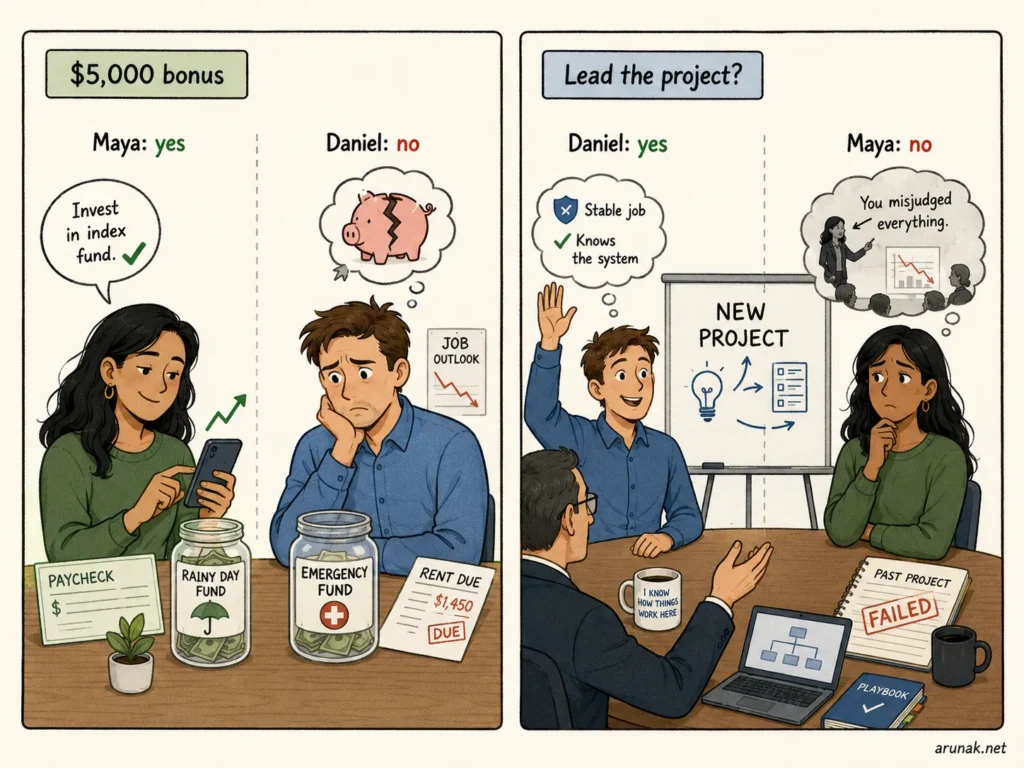
For example, imagine two people—let’s call them Maya and Daniel—being offered a choice.
They’ve just received a $5,000 bonus from their job. Totally unexpected, and they are thrilled!
Now, imagine they are given the opportunity to invest this $5,000 in a stock-market index fund, knowing that its value could drop in the short term but also has the potential to grow substantially over many years.
Would they invest?
Maya says yes. She has a stable income, six months of expenses saved for a rainy day, and no immediate need for the money. Even if the market falls, she can leave the investment alone and wait.
Daniel says no. The same $5,000 is his entire emergency fund. His job security is shaky, and one unexpected expense could easily force him to withdraw the money at the worst possible time, when stock prices have plummeted.
Looking at this one decision, it is easy to assume that Maya is the more risk-tolerant one of the two.
Right?
Well, let’s put them through another round, this time with a different kind of risk.
A few weeks later, their manager asks whether anyone wants to lead a new project.
This is a completely new undertaking, so it comes with plenty of unknowns. It could bring a promotion, but it could also lead to a huge embarrassment in front of the team.
Daniel volunteers. He knows how things work around there, trusts his colleagues, and knows that even if the project goes badly, his position is relatively secure.
Maya, on the other hand, stays oddly quiet…
She was publicly blamed for a failed project recently.
Yes, she can tolerate the financial uncertainty of the stock market, but the possibility of another project failure would be a catastrophe for her.
The roles have flipped. The risk-taker has become the risk-averse one.
This is why the question “Why am I so risk-averse?” can be misleading at times. It assumes that risk aversion is a fixed part of your personality, as though some people are simply brave and others are not.
But it’s more complex than that. Risk tolerance is a moving benchmark.
It depends on what you could lose in the process, what might happen in the near future, and how much control you have over the outcome.
Understanding this is just as important as acting on it. Before making a decision, we need to assess the situation in front of us, adjust our risk tolerance accordingly, and ask whether the risk is one we can realistically absorb.
That is what this article is about: how to evaluate the risk in front of you and make better decisions using a seven-step process.
Table of Contents
Why am I so risk-averse? The short answer
Losses loom larger than gains.
When your own past experiences have already shown you that mistakes are quite difficult to recover from and can take away both your money and your confidence, you naturally want to step back when a hard decision has to be made.
But what you may not yet realize is that this cautiousness is probably specific to one area of your life (you may be cautious when it comes to your career while taking risks comfortably in other parts of life) and is not a fixed personality trait.
Sometimes, being risk-averse is not such a bad thing
We have this common misconception that being cautious when making a risky decision is always a bad thing.
The saying goes, “fortune favors the bold.”
But sometimes, good things happen to people who wait. Having a fair amount of risk aversion is not such a bad thing.
For example, in finance, researchers and regulators separate risk tolerance—how much risk you are willing to take—from risk capacity—how much loss you can actually afford to absorb.
And its influence goes far beyond money.
For example, quitting a bad but stable job isn’t much of a risk for someone with a year’s worth of savings and family support, but it’s quite a different decision for someone who lives from paycheck to paycheck.
Another important factor is reversibility.
Annie Duke, the author of Thinking in Bets, argues that when we are given a choice with room to test the outcome and, if needed, reverse the decision before any serious damage is done, it becomes much easier to take the risk.
So, being cautious is not such a bad thing after all, especially when the possible losses are too much to handle, when the decision is difficult to reverse without serious consequences, or when the loss would be hard to absorb given our financial, mental, and emotional situation.
This is why the idea that being risk-averse is always a weakness doesn’t really make sense.
Sometimes, it’s the right thing to do.
That said, this article isn’t meant to diagnose anxiety or any other mental-health condition.
If you find yourself experiencing persistent distress that interferes with work, school, relationships, or daily life in general, it’s worth speaking with a qualified professional.
You may not be risk-averse in every part of your life
As mentioned above, it’s highly likely that you’re not risk-averse when it comes to everything.
That’s because risk aversion is often domain-specific.
One of the most widely used measures is the Domain-Specific Risk-Taking Scale, or DOSPERT, which examines risk-taking across five broad areas: financial, health and safety, recreational, ethical, and social decisions.
And the conclusion is that it’s highly unlikely for anyone to have the same attitude toward risk across all five areas.
You might be extremely cautious when it comes to handling money but have no trouble travelling alone for months on end with very little planning, confronting someone at work, or trying cave diving with absolutely no prior experience.
Someone else might say “hell no” to all of that, but they’d happily spend money without worrying too much about every purchase.
These differences in risk tolerance are also shaped by how we see the decisions in front of us.
Someone might see spending $600 on a coffee machine as a complete waste of money and wonder how they’re going to balance their finances for the month after such a large purchase. But someone else in the same financial position might see it as a “necessary investment”.
So, the question “Am I a risk-averse person?” always comes with conditions.
The more accurate question would be: “Why am I being so risk-averse when it comes to this particular decision?”
So, let’s explore some of the reasons certain decisions can make us more risk-averse than others.
Six reasons why you may be more risk-averse than other people
The possible loss seems to outweigh the possible gain
Imagine that you have an okay job.
It’s not great. But at least it pays the bills.
And then, you come across a job posting that’s so much better.
It closely matches your interests, and the salary is much better too.
It’s just the perfect gig.
But you’d still hesitate to leave your current job and apply for it because you don’t want to sit with the uncertainty for even a second.
Yes, this new job looks incredibly promising. But even though you’re fairly confident that your expertise matches the description, there’s still some uncertainty about whether you’d be accepted if you applied.
At this point, you’d imagine the worst-case scenario.
What if I “rage quit” my current job and then get rejected by the new company?
What then?
In behavioural economics, this is called the certainty effect, a concept explained in prospect theory.
People are often more likely to put greater weight on the guaranteed outcome—in this case, staying with the current job and its “good enough” salary—than on an option that comes with a certain amount of uncertainty.
But it’s important to separate this preference for certainty from a general dislike of risk.
If, for example, you know for sure that you’re going to be laid off within a couple of months, making that leap and applying for the new job would not feel like much of a risk.
The amount of risk you’re willing to take in this kind of situation depends partly on how much definite loss is attached to each option.
In other words, loss aversion, even though it’s related, isn’t the same as risk aversion.
A question to ask in a situation like this is: What possible loss am I treating as a certainty, and is it really a definite loss? Is it reversible, or could it be reduced or avoided entirely?
Your past experiences have taught you that mistakes are quite hard to recover from
We’d like to believe that history repeats itself.
There’s some truth to it, yes, but relying too heavily on this idea would lead us to miss opportunities we might otherwise take if we were more open to calculated risks.
If you’ve found yourself facing repeated losses because of decisions you made in the past, you’re naturally going to become more risk-averse.
It’s quite obvious.
But it’s important to remember that decision-making is more like playing poker.
You bet with the cards you’re dealt, choosing the option with the highest probability of success.
You can’t beat yourself up because someone else got a better hand than you did.
How could you possibly have known?
What I’m getting at here is that some of the losses you’ve experienced may have come from bad decisions.
But they might also have come from the best decisions you could’ve made given the circumstances.
The outcome carries some uncertainty.
It always does.
In the book Thinking in Bets, Annie Duke calls this “resulting”: judging a decision only by its outcome.
But the part we often overlook is that life isn’t mechanically linear. Like poker, it’s a game filled with uncertainty, incomplete information, hidden variables, and also…luck!
So, when you find yourself in a situation like this, ask yourself: Am I really responding to the consequences in front of me, or to consequences I’ve already experienced in the past?
You don’t have enough mental or financial capacity to recover if things go wrong
Sometimes, you’re mentally well prepared to go all in.
But your wallet says no!
Put this way, we can see that they’re two completely different things.
But in practice, they’re often fused together so closely that we think they’re the same.
In the financial world, these two are categorized as risk tolerance and risk capacity.
Risk tolerance is your willingness to absorb uncertainty. Risk capacity, on the other hand, is your actual ability to absorb a loss without jeopardizing your essential needs or long-term goals.
This distinction also holds up outside the financial domain.
For example, as discussed above, you may be willing to change careers, start a business, or return to school to complete a degree, but it might be quite hard to do because you have limited time to spare, poor health, or family responsibilities holding you back.
So, these are in no way forms of cowardice.
Sometimes, it’s just the right thing to do.
It’s quite natural—and in many ways, logical—to protect valuable resources, including money, time, energy, and social support, especially when those resources are already limited and invaluable.
Sometimes, being courageous is only virtuous after you’ve built a solid safety net that allows you to make a good, well-calculated decision.
There is too much ambiguity around the outcome
Sometimes, you just don’t have enough facts to make a calculated decision.
It’s not that the odds are bad. You just don’t know what the odds even are.
Would you drive on a highway at midnight if you couldn’t see more than a few metres ahead?
Probably not. It’s not even about whether or not you’re willing to take a risk. It would just be foolish.
Seen this way, as before, you begin to notice that risk and ambiguity are two very different things.
Under risk, the possible outcomes and their probabilities are at least roughly known.
But that’s not the case with ambiguity.
It’s simply a blank. Some crucial information is completely missing.
Research has found that many people prefer the option with clearer probabilities, even when the ambiguous option isn’t necessarily worse.
This is known as ambiguity aversion.
Think about a career change.
You might not be making a fortune, but at least you know exactly what you earn.
But a job you really like, which is obviously an upgrade in many ways, doesn’t really guarantee anything.
The salary is higher, but it’s listed as a range. You’re not sure whether you’d be offered the lower end, which may be even less than what you earn now, or the higher end, which could be around $20,000 more.
Because you can clearly see the possible loss but have no idea what the actual outcome will be, sticking with your current job might seem like the safer option.
But you can reduce some of this ambiguity by defining a few guardrails and doing some background research—for example, speaking with current or former employees, reviewing salary data, or asking the recruiter how the final offer is determined.
But having an endless amount of information isn’t always the answer.
There’s plenty of research showing that, in situations like this, we tend to keep searching for information until we reach a desired level of confidence. But when that threshold is unrealistically high, the search becomes a never-ending treasure hunt. It turns into another form of procrastination and doesn’t get us any closer to making a calculated decision.
So, it’s important to define some guardrails—what exactly you need to know and when you’ll stop—before jumping into “research mode.”
Because the goal isn’t to be 100% certain. That’s impossible.
It’s to know enough to make a sensible next move.
You have almost no control over the outcome
If the outcome of a decision depends heavily on other people and events you have no control over, making that decision could be reasonably overwhelming.
So, in a case like this, we’d think twice before making a decision and, sometimes, wouldn’t make one at all.
Consider applying for a new job.
There are certain things within your control, like your résumé and cover letter.
You can do all the necessary research and prepare them carefully without mistakes, and possibly create an application that makes you stand out, at least objectively.
But you have no idea how the hiring manager will see your application.
You don’t know their preferences or the hidden criteria they’re using for the role that weren’t included in the job description.
So, when you hear that it’s a six-interview process, all the way from the HR manager to senior leadership, you begin to wonder, “Is it really worth my time to prepare the documents and apply for this role?”
It’s quite a natural and logical concern.
But mind you, the answer isn’t to pretend that you can control the final result. Most of the time, that’s not going to be possible. It would only create an illusion of control.
Instead, what we can do is decide the nature of the “bet”: how much money you’re willing to put into it, how much time you’re willing to spend on it, or how much of your reputation you’re willing to put on the line.
You can’t control the weather, but it’s not much trouble to bring an umbrella.
Being “the responsible one” is important to you
In a friend group, a family, or a community, there’s always a “stable” one: the one who provides, the one who always gives the most reliable information, or the one who makes sure everybody else is taken care of.
That person might be you.
And if that’s the case, leaning toward being more risk-averse would be part of the job.
Because you can’t afford to make mistakes.
This is your identity-based motivation at play.
It pushes people to choose actions that align with who they believe they are.
If being dependable is part of your identity, experimenting with a new career or a startup can sometimes seem a bit irresponsible, even if the downside wouldn’t be that hard to recover from.
In many cases, yes, this is a really logical thought process. But it might unnecessarily limit someone’s true potential and, in turn, the very people they’re trying to support.
A good way to break out of this bubble is to “start small”: build an investment portfolio or savings account on the side, or test some ideas before going all in.
If you’re this kind of person, a good question to ask yourself is: Does the safe path I’m taking support other people’s well-being over the long run, or is it simply reinforcing my identity as the responsible one?
How to tell whether being risk-averse clouds your judgement
So, the next question is: Is there a way to tell whether being risk-averse gives you an advantage in a given situation or gets in the way of making a good decision?
There are a few ways to tell which is which.
One sign that being risk-averse is clouding your judgement is that you keep “doing research” even though you know for a fact that none of the new information coming in is going to change your decision.
For example, I used to do an enormous amount of research, sometimes for days on end, before investing in the stock market to find the right index fund, even though I knew that the only information I needed to make my decision was “just buy a well-diversified, low-cost index fund,” which I realized pretty much ten minutes into my research.
This is reportedly a common pattern among many people across many different kinds of decisions.
The problem here is that we all want 100% certainty in situations where, in reality, we’ll never be able to get it.
Another sign of being overly risk-averse is creating the whole plan and calculating all the downsides and risks, but stalling when it comes to actually making the decision.
This is nothing but “toxic productivity”!
More accurately, in economics and behavioural science, it’s related to status quo bias, where someone is more likely to favour their current situation simply because it’s already in place.
You might also be overdoing your risk assessment if you’re planning to get the whole pie at once and aren’t willing to take small, periodic steps toward the final goal.
It’s like trying to leap across a river in one jump instead of carefully stepping from one rock to the next.
A question to ask yourself in a situation like this is: If I don’t make this decision now, will it trap me in a corner two years from now, or leave me with more options?
Not taking any risks is its own kind of risk
Building on the question from the previous section, sometimes the riskiest thing you can do is “nothing.”
It might seem like the safest option now, but over time, you may realize that “doing nothing” was also an action you took. And sooner or later, it comes with its own set of consequences.
This is the previously discussed status quo bias in action.
And there’s an opportunity cost attached to not taking any risks too.
While trying to protect what you have now, you’re potentially giving up the skills you could’ve developed, a bump in your income, or an improvement in your relationship with a loved one.
For example, a common piece of career advice is not to stay in the same company—or job role—for too long without reassessing your growth.
But because of status quo bias, people tend to stay put in their jobs, even though they could ask for a promotion or apply for a much better role that matches their current expertise.
With the current uncertainty in the job market, staying in one job like this can slowly limit your career, even though you might not realize it yet because you’re blinded by the comfort of familiarity.
The same rule applies to regret.
If you make a mistake by “doing something,” it often leads to immediate regret.
But it can take a long, long time to realize that you made a mistake by doing nothing.
The worst part is that, because it takes so long to recognize, unlike in the previous case, by the time the regret hits you, there may be nothing you can do to reverse it.
But of course, this doesn’t mean that “taking action” is the all-in solution to avoiding risk. The point is that inaction should also be considered part of the decision-making process, which we usually don’t do.
In a situation like this, ask yourself: “What could possibly go wrong if I make this decision?” But also, “What could possibly go wrong in the future if I don’t?”
How to take more calculated risks without being reckless
So, let’s boil down everything discussed in the previous sections into a seven-step process.
The goal of this process is to have some control over the decision-making process, not over the final outcome, which we can rarely control.
Step 1. Clearly define the risk
Sometimes, the biggest issue with risk-taking is that we don’t really know what kind of risk we’re actually taking.
For example, “changing careers is risky” is too vague. Instead, it gives you more control if you define the risk in clear-cut terms, like this: “Should I spend six or eight hours a week working on my side hustle so that I can eventually move into it full-time and leave my current job?”
This kind of precise decision lets you clearly see the potential costs, benefits, and probability of success, and keeps you from being guided by vague emotions.
Step 2. Separate the worst case from the most likely case
Let’s say you’re faced with making a decision.
If it were to go wrong, can you imagine what the worst-case scenario would be?
The question “What’s the worst that can happen?” should be more than just a phrase we throw around. If we take it seriously and answer it honestly, it can genuinely help us to take well-calculated risks.
But it’s also important not to treat every imaginable disaster as equally likely.
What is possible and what is probable are two different things.
Projects fail at a spectacular rate. One reason is that too many people are reluctant to speak up about their reservations during the all-important planning phase. By making it safe for dissenters who are knowledgeable about the undertaking and worried about its weaknesses to speak up, you can improve a project’s chances of success.
—Gary Klein, “Performing a Project Premortem”
Step 3. Gauge your capacity to recover if things were to go sideways
Your willingness to take a risk and your ability to absorb its consequences are two very different things.
So first, it’s worth considering the resources available to you: your finances, available time, health, obligations, and how long it would take to regain stability.
If you realize that you fall short in one or more of these areas when it comes to recovering from a bad outcome, it’s time to step back and build a better safety cushion first.
Step 4. Make the decision more reversible
Flexibility is one of the most valuable assets in calculated risk-taking because it allows you to recalibrate your decision as new information comes in.
Some of the ways you can build in more flexibility are:
- Running trials first
- Making only part-time commitments while testing the waters
- Defining clear deadlines
- Having predefined exit conditions in place
Step 5. Run a small experiment
It’s tempting, especially if you’re more of a risk-taker, to go all in expecting a huge reward.
This is courageous, yes, but it might not be as effective as you think, at least not 100% of the time.
Instead, the more logical thing to do is to run small experiments first.
These small experiments could include:
- Testing the demand before launching a website, YouTube channel, or business
- Shadowing someone who is already doing well in a field you want to excel in
- Publishing your thoughts on social media before launching a product to see how well they engage your target audience
Step 6. Set a stopping rule
We tend to keep searching until we reach a certain level of confidence before making a decision.
That’s a good thing.
But sometimes, we tend to overdo it, which is really just procrastination.
So, it’s quite helpful to define a few rules before diving headfirst into all the research.
These rules could be:
- Deciding what type of evidence you need to make a calculated decision
- Deciding whose opinions matter most to you
- Setting a clear deadline for when you’ll stop researching and make the decision
Step 7. Judge the process separately from the outcome
Good decisions and good outcomes are not the same thing.
And you only have so much control over how the outcome unfolds.
But what you can control is your decision-making process.
True, it takes real “guts” to separate the outcome from the decision-making process.
But more often than not, this is a better way to make a good decision given the circumstances than becoming emotionally attached to every possible outcome that might go wrong.
So, the point is to make the grey area between making the decision and succeeding at it as narrow as possible.
If there’s no grey area at all, well…it’s not really a decision, is it?!
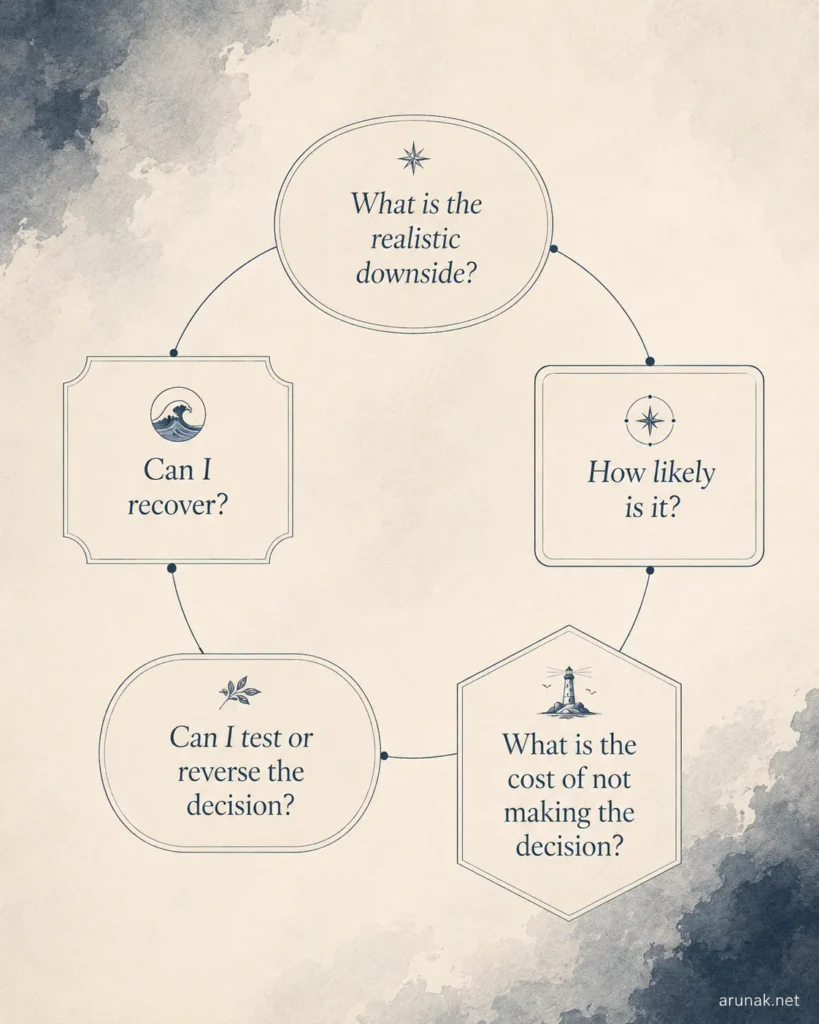
The five-question calculated-risk test
Here are five quick questions to consider when faced with a difficult decision, distilled from the previous seven-step process.
- What is the realistic downside?
- How likely is it?
- Can I recover?
- Can I test or reverse the decision?
- What is the cost of not making the decision?
Worked example: taking a career risk through controlled decision-making
Now, with all these insights, let’s see how you could put them into practice.
Let’s say that you have a stable job right now that pays the bills and provides enough mental stability to get on with your life.
But nothing more…
You feel like there’s no real meaning to this job that aligns with who you really are. You feel that you need to make a change and find a career that truly fits you.
But “rage quitting” wouldn’t only put you in a difficult financial situation. It could also affect your family if they depend on your income.
The rent, your savings, and your family responsibilities are all on the table.
So, what would you do?
The first step is to change the decision entirely.
Let’s say you’re working in the financial sector but desperately want to change your career and move into technical writing.
Instead of asking, “Should I leave my career?”, ask, “How much time, and for how long, should I spend testing whether technical writing really suits me?”
That’s a great start, and it’s quite achievable.
The other important thing this changes is that you’re taking action, rather than simply reflecting on quitting.
And nobody’s really at risk here either.
You can spend several evenings and weekends taking online courses, learning the software, and testing it out to see whether you really like it.
You haven’t even touched your earnings, and you’re still receiving a salary, so a disappointing result wouldn’t put your housing at risk or threaten your essential savings.
Also, not to be a downer, but sometimes, the idea of liking something doesn’t mean that you’ll actually enjoy doing it every day.
And there’s only one way to find out: by doing it. Then you can check that box and move on to the next interest that you think is worth exploring.
So, let’s say you decide to try this out for eight weeks. What would you do?
There are many tiny experiments you can run. For example:
- Rewrite a technical guide
- Create a portfolio sample using your own work
- Help a small organization improve its documentation
- Connect with three technical writers to learn about their daily work, hiring requirements, and career paths
- Then ask some—or all—of them to critique your writing portfolio
Doing this helps you get the “whole picture”: both the work itself and the professional identity that comes with it.
This kind of experimentation is described as trying out “provisional selves”: possible versions of yourself that you evaluate through experience and feedback.
After these eight weeks, you’re in a much better position to make a calculated decision than if you had simply asked yourself, “Should I quit my job?”
Frequently asked questions
Is being risk-averse bad?
No.
In fact, being risk-averse in some situations is the right way to handle things.
It can prevent painful and irreversible losses.
However, it can also hold you back when you have the capacity to move forward with manageable uncertainty, but still choose not to.
This can be a form of status quo bias.
Is risk aversion a personality trait?
No, it’s not perfectly fixed or universal.
Our risk preferences depend on many factors.
The same person could be risk-seeking in one area of life while being severely risk-averse in another.
It all depends on the situation they’re in.
What is the difference between risk aversion and loss aversion?
Risk aversion is a preference for greater certainty or lower variability when making decisions.
Loss aversion, on the other hand, describes a person’s tendency to give more weight to potential losses than to equivalent gains.
The two can interact when we make decisions, but they’re not identical.
Can I become less risk-averse?
Yes.
There are many ways to become more comfortable with uncertainty, including doing thorough research, building a larger financial buffer, and taking smaller, reversible risks.
What is the opposite of risk-averse?
The opposite of risk-averse is risk-seeking.
The middle ground is risk-neutral, which describes someone who makes a decision based on the expected outcome without preferring or avoiding the uncertainty surrounding it.
Is it risk-averse or risk-adverse?
Risk-averse is the standard expression.
Averse means opposed or disinclined, while adverse means harmful or unfavorable.
Conclusion
So, it’s clear. If you’re a risk-averse person and willing to work on your risk tolerance so you can make better decisions in the future, the goal should be to break the decision in front of you into smaller pieces.
Some risks are huge and come with uncertain odds, whereas others are only a few hours of focused research away from becoming much easier decisions to make.
That said, the most important trap to avoid is the idea that you can completely control the outcome when making a decision.
It’s not possible.
But what is possible is making the best decision you can, given the circumstances.
References
Anderson, C. J. (2003). The psychology of doing nothing: Forms of decision avoidance result from reason and emotion. Psychological Bulletin, 129(1), 139–167. PubMed
Arvai, J. (2007). Win some, lose some: The effect of chronic losses on decision making under risk. Journal of Risk Research, 10(8), 1085–1099. Taylor & Francis Online
Baron, J., & Hershey, J. C. (1988). Outcome bias in decision evaluation. Journal of Personality and Social Psychology, 54(4), 569–579. PubMed
Bowman, E. H., & Moskowitz, G. T. (2001). Real options analysis and strategic decision making. PDF
Bühren, C., et al. (2021). Ambiguity aversion: Bibliometric analysis and literature review of the last 60 years. PubMed Central
Canadian Investment Regulatory Organization. (n.d.). Know-your-client and suitability determination for retail clients. CIRO
Canadian Investment Regulatory Organization. (n.d.). Understanding risk. CIRO
Chen, S., Westman, M., & Hobfoll, S. E. (2015). The commerce and crossover of resources: Resource conservation in the service of resilience. Wiley Online Library
Edmondson, A. C. (1999). Psychological safety and learning behavior in work teams. Administrative Science Quarterly, 44(2), 350–383. SAGE Journals
Ellsberg, D. (1961). Risk, ambiguity, and the Savage axioms. Quarterly Journal of Economics, 75(4), 643–669.
Gilovich, T., & Medvec, V. H. (1994). The temporal pattern to the experience of regret. Journal of Personality and Social Psychology, 67(3), 357–365. PubMed
Gilovich, T., & Medvec, V. H. (1995). The experience of regret: What, when, and why. Psychological Review, 102(2), 379–395. PDF
Han, Q., Quadflieg, S., & Ludwig, C. J. H. (2023). Decision avoidance and post-decision regret: A systematic review and meta-analysis. PLOS ONE, 18, e0292857. PLOS ONE
Hanushek, E. A., et al. (2022). Different degrees of skill obsolescence across hard and soft skills and the role of lifelong learning for labor-market outcomes. IZA Discussion Paper. IZA Institute of Labor Economics
Hausmann, D., & Läge, D. (2008). Sequential evidence accumulation in decision making: The individual desired level of confidence can explain the extent of information acquisition. Judgment and Decision Making, 3, 229–243. Cambridge University Press
Hobfoll, S. E. (1989). Conservation of resources: A new attempt at conceptualizing stress. PubMed
Ibarra, H. (1999). Provisional selves: Experimenting with image and identity in professional adaptation. Administrative Science Quarterly, 44(4), 764–791. SAGE Journals
Ibarra, H. (2023). Working identity: Unconventional strategies for reinventing your career (Updated ed.). Harvard Business Review Press. Harvard Business Review Store
Ibarra, H. (n.d.). Why career transition is so hard—and how to manage it better. Herminia Ibarra
Kahneman, D., & Tversky, A. (1979). Prospect theory: An analysis of decision under risk. Econometrica, 47(2), 263–291. Massachusetts Institute of Technology
Kim, A., Vanheusden, F., & Rashid, M. (2026). Personal values, family security, and financial risk-taking: A survey of UK households. European Research on Management and Business Economics. ScienceDirect
Klein, G. (2007). Performing a project premortem. Harvard Business Review. Harvard Business Review
Kocher, M. G., Lahno, A. M., & Trautmann, S. T. (2018). Ambiguity aversion is not universal. ScienceDirect
Köbberling, V., & Wakker, P. P. (2005). An index of loss aversion. ScienceDirect
Langer, E. J. (1975). The illusion of control. Journal of Personality and Social Psychology, 32(2), 311–328. EBSCOhost
Leotti, L. A., Iyengar, S. S., & Ochsner, K. N. (2010). Born to choose: The origins and value of the need for control. Trends in Cognitive Sciences, 14(10), 457–463. PubMed
McGlothlin, W. H., et al. (2017). How do prior gains and losses affect subsequent risk taking? Management Science. INFORMS PubsOnline
Miller, L. T., & Park, C. S. (2002). Decision making under uncertainty—Real options to the rescue? Taylor & Francis Online
Mutual Fund Dealers Association. (n.d.). Discussion paper on the use of investor questionnaires. Canadian Investment Regulatory Organization. CIRO
OECD. (2026). A skills-first labour market. OECD
Oyserman, D. (2009). Identity-based motivation: Implications for action-readiness, procedural-readiness, and consumer behavior. Journal of Consumer Psychology, 19(3), 250–260. ScienceDirect
Richardson, J., et al. (2023). A very public replication of the temporal pattern to people’s regrets. Royal Society Open Science. PubMed Central
Samuelson, W., & Zeckhauser, R. (1988). Status quo bias in decision making. Journal of Risk and Uncertainty, 1, 7–59. Harvard University
Sitkin, S. B. (1992). Learning through failure: The strategy of small losses. Research in Organizational Behavior, 14, 231–266. Scholars@Duke
Van Dolder, D., et al. (2024). Behavioral risk profiling: Measuring loss aversion of investors. ScienceDirect
Van Dyck, C., Frese, M., Baer, M., & Sonnentag, S. (2005). Organizational error management culture and its impact on performance. Journal of Applied Psychology, 90(6), 1228–1240. Vrije Universiteit Amsterdam
Wenke, D., et al. (2019). Sense of agency as a predictor of risk-taking. Acta Psychologica, 197, 10–15. Utrecht University