
One-line takeaway
Nobody can reach mastery; it exists only in the pursuit.
What is Mastery about?
Though the content of Mastery has been widely discussed in all corners of the internet, I find that the way it’s been discussed doesn’t really do justice to the book. The book lays out a six-step process to mastering a craft: find your calling, complete an apprenticeship, learn from a mentor, develop social intelligence, become creative, and eventually gain an intuitive command of your field.
But deep within this “hero’s journey” type narrative, is a message that almost contradicts the conventional idea that “the journey is the reward.”
Greene argues that mastery is not something that waits for you at the end of a long, hard-fought journey. It’s not as simple as it’s been made out to be in pop psych culture. Rather, you’ll find it when you’re excited to hit the road as many times as it takes, and get to know each and every bend along the way.
The point, then, is not to reach some glamorous final state, but to develop a tight relationship with reality through deliberate practice, honest criticism, constant feedback and, most importantly, genuine curiosity in the field you want to be a master of.
Why I picked up this book
Having previously read another of his books, The 48 Laws of Power, I’ve always been curious about his other work.
Despite its somewhat infamous reputation, I saw real value in The 48 Laws of Power, provided its ideas were used in the right context. So, the decision to read another of his books, Mastery, came quite naturally.
Key Takeaways from Mastery by Robert Greene
What is “Your Life’s Task”?
The common thread that connects the entire book is the notion that there is something in this world that you were born to do.
Greene calls it your “Life’s Task.”
When you look all the way back to your childhood, Greene says, you’ll begin to see certain things that you always liked to do, things that separated you from others, things that defined who you are. These are the recurring fascinations and activities that you wholeheartedly loved, mostly without really having a reason to do so.
Eventually, you will hit upon a particular field, niche, or opportunity that suits you perfectly. You will recognize it when you find it because it will spark that childlike sense of wonder and excitement; it will feel right.
And you did them regardless of money, other people’s expectations of you, status, or fame.
What I like about this idea of a Life’s Task is that it has some grounding in psychological and longitudinal research, though at first it might seem like just another cheap motivational pill.
This isn’t just nostalgia.
It also goes well beyond the mainstream self-help advice of “find your passion, and everything will fall into place.”
Your Life’s Task doesn’t necessarily align with passion.
What do you have to do to find out what you’re passionate about?
Just ask yourself.
But finding your Life’s Task takes a lot of work.
A hell of a lot more, to be precise.
Because it can only be found through “evidence.”
It existed in your childhood, and it probably still does, even though it might have been clouded by the societal noise of fame, money, prestige, and other people’s expectations.
A false path in life is generally something we are attracted to for the wrong reasons—money, fame, attention, and so on. If it is attention we need, we often experience a kind of emptiness inside that we are hoping to fill with the false love of public approval.
So, from a more practical standpoint, your Life’s Task is a set of inclinations and skills that can be directed towards many different jobs, industries, or forms of work, all supported by recurring evidence. Passion, on the other hand, usually gets attached to just one “job”, which would be a much weaker reflection of who you are and what you’re capable of.
In this sense, it makes the idea all the more practical, too.
If you discover it, you’ll get so many more options to move forward in your professional life. You don’t have to follow one narrow ladder upwards and end up committing to one job forever.
It gives you the freedom to explore.
So the next big question is: “How do you find your Life’s Task?”
Greene’s advice is to start looking for things that have always grabbed your interest, like understanding how things work, explaining ideas to others, making and building things, solving complex problems, writing, teaching, or creating.
The way I like to look at this is through a line by investor John C. Bogle in his book The Little Book of Common Sense Investing: “If you can’t find the needle, just buy the haystack.”
So, yes, a Life’s Task isn’t so easy to find.
It needs some doing.
But what you can do quite easily is gather “all the evidence”, very similar to what crime detectives do. Then you connect the dots, eliminate what doesn’t fit, and keep narrowing things down until everything points to one single culprit.
That’s your “Life’s Task.”

Finding Your Life’s Task: From Creative Chaos to a Central Point of Orientation.
Greene also points out that our Life’s Task isn’t set in stone.
It can change.
It can change with age, maturity, and the resources available to you. The career you set your sights on in your early 20s may look completely different in your 30s, when you have more experience and a decade’s worth of lessons.
So the point is to commit to a type of contribution that you can make to other people, not necessarily to a job title.
In practice, keeping an “inclination record” is one of the most effective ways to stay dynamically aligned with your Life’s Task. For example, being mindful of: (1) What kind of work gives you more energy? (2) What do people most often ask for your help with? (3) What kind of work do you consistently go above and beyond on, even though nobody asked you to?
The apprenticeship phase: Observation, Deliberate Practice, and Experimentation
So, let’s say, after a lot of pondering and running experiments, you’ve finally found your Life’s Task.
Then what?
Does that make you a “master”?
Greene says no.
It’s just the beginning. Finding it is still great because now you’re in a race that you know plays to your strengths. If, after gathering enough evidence, you realize that you’re unusually good at breaking complicated problems apart, spotting patterns that’d go over others’ heads, then you’ve got a much better shot at finding a field where you can really hit your stride.
Then comes the “apprenticeship phase”, where you hone the skills aligned with your Life’s Task well enough that you can actually help somebody else with them.
The goal here is to get exceptionally good at what you do, so that you become the best helper around the block and become “a master”.
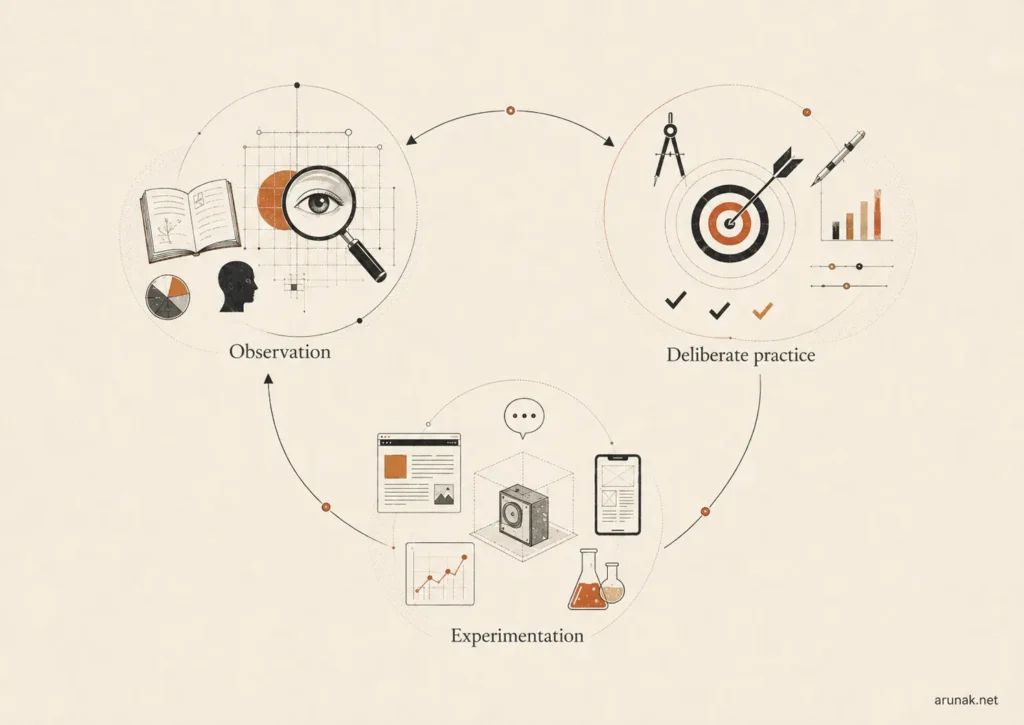
Greene divides this into three phases:
- Observation,
- Skill acquisition, and
- Experimentation.
The observation phase naturally comes first because every domain has its own underlying set of rules: the blueprint on which the whole foundation is built. But, like a blueprint, it’s quite elusive from the outside; all we usually see is the finished building. So discovering it takes some real work.
A lot of it.
Then, and only then, Greene says, should you really dip your toes into the skill acquisition phase.
Because now you’re ready.
You’ve already tested the waters.
But this should be more than simply accumulating work hours if you really want to become a master. Those hours have to be spent deliberately.
Greene calls this “Resistance Practice”: instead of repeatedly practising the same things with the same intensity, you focus deliberately on the weaknesses after each and every practice run. This idea lines up remarkably well with another book I read recently, Peak by Anders Ericsson and Robert Pool, which develops the idea that repetition without a meaningful feedback loop isn’t going to get you very far.
Finally comes the experimentation phase, where you start generating “outputs”. Depending on the domain you’re honing your skills in, this could be:
- Publishing an article to see whether you can explain a complicated idea clearly to a real audience, or
- building a small working prototype before launching the final product on a manufacturing line.
Greene suggests that these phases will keep recurring, so there’s no need to finish the skill acquisition phase before jumping into the experimentation phase.
There really is no such thing as “finishing” skill acquisition, for example. Experimentation exposes weaknesses that send you back to practice more deliberately. And deliberate practice helps you notice things you couldn’t have otherwise noticed during the observation phase. And better observation readjusts what you’d practise next.
So all three phases form one continuous feedback loop:
observe → practise → experiment → observe again.
Social intelligence is an indispensable part of the path to mastery
The chapter in which Greene discusses “social intelligence” first seemed like a detached piece of this narrative.
At least, that’s how I saw it at first, only to realize that it’s as integral to the equation as any other part of the process.
The top-level logical sequence for understanding why this is the case would go something like this:
- There’s no master without the people he or she serves.
- The stronger and more meaningful the bond between the master and the people they serve, the more capable they become of being a true master.
- In other words, one can only hone competence in relation to the people who are in need of that competence.
- So, social intelligence inevitably plays a key role in becoming a true master.
Understanding the nuances of the domain, navigating people’s egos, reading alliances, and dealing with enemies all take a certain amount of intelligence, and without it, no one can rise far above the ordinary.
One can be excellent at what they do but fall short when it comes to reading other people, which can easily cost them opportunities, more often than not to people who possess less expertise than they do but considerably more social intelligence.
Greene calls this distorted way of seeing other people’s perspectives the Naïve Perspective, where we might blindly idolize people while ignoring all the evidence in front of us, or fall back into demonizing others whenever they repeatedly disappoint us.
The solution to this, Greene suggests, is to look for evidence: the actual outputs and behaviour of the people below and above us, taking into account what they do, not merely what they say they do.
And this applies remarkably well to ourselves, too.
Being a suspicious observer of your own behaviour is also a sign that you’re moving towards mastery.
The Dimensional Mind: the creativity paradox
In this chapter, Greene goes on to draw a spectrum between knowing nothing and knowing everything, with our best creative self positioned somewhere in the middle.
The term he uses for this is the “Dimensional Mind”: one has the openness of a child and the discipline of an expert.
I find this particularly fascinating because the idea holds up quite well in real life.
A child is open to learning and fascinated by almost everything. But they’d probably have zero expertise in any given domain.
A well-seasoned expert in a field, who has devoted decades to honing their skills, on the other hand, would probably know nearly everything about their craft. And if they’re not careful, or not willing to open themselves up to the notion that there are still things they don’t know they don’t know, their expertise can also become their demise.
Some people maintain their childlike spirit and spontaneity, but their creative energy is dissipated in a thousand directions, and they never have the patience and discipline to endure an extended apprenticeship.
Creative mastery, Greene argues, requires both of these personas to coexist within us.
You can’t become stuck at either end of this spectrum and expect to keep breaking new ground.
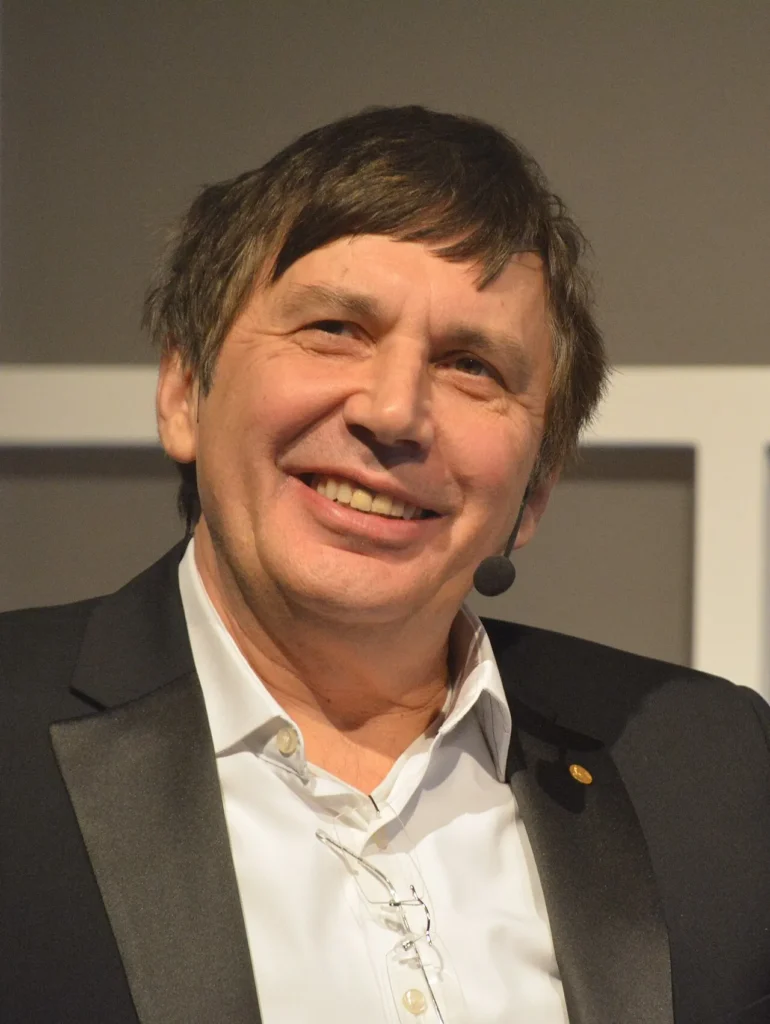
A great example that comes to mind is scientist Andre Geim. Despite already being a well-accomplished physicist, he’d run experiments on whatever happened to catch his curiosity in his free time, which he called “Friday night experiments.”
These experiments had very little to do with his main line of work. He just did them for fun, out of sheer excitement for his craft.
One of those Friday night experiments eventually led him to his groundbreaking work on graphene, which, in 2010, won him the Nobel Prize in Physics.
Intuition Is Just Experience in Disguise
What comes to mind when we hear the word “master”?
Sherlock Holmes, whom I used to love as a child, is probably one of the clearest examples. He walks into a room, glances at something or someone for a second or two, and is able to tell a dozen things that completely go over Dr. Watson’s head.
And he’s always right, too.
This is fiction, yes, but there are people like this in the real world whom we’ve all, at some point, come across. Good ideas seem to come almost instinctively to them.
Like magic.
It almost seems as though they were born with these skills, though, really, there are thousands of hours of observation, dead ends, and pattern recognition in the past that we don’t get to see.
It’s the mastery phase that makes a good story, not the boring apprenticeship phase.
There’s no magic. It’s just hard work. And when a master has all those accumulated years behind them, they naturally develop a sort of “sixth sense.”
They’re so deeply attuned to their craft that they see things others don’t, which, to someone on the outside, can seem like pure magic.
And that’s the point Greene makes in this later part of the book: intuition is nothing but a proxy for years of accumulated experience.
People who spend years studying a particular subject or field develop so many of these memory networks and pathways that their brains are constantly searching for and discovering connections between various pieces of information. When confronted with a high-level problem, the search goes in a hundred directions below conscious awareness, guided by an intuitive sense of where the answer might lie. All kinds of networks become activated, ideas and solutions suddenly rising to the surface.
As Pasteur himself commented, “Chance favors only the prepared mind.”.
But Greene is also careful to point out that intuition and reason shouldn’t be treated as the same thing.
“Follow your gut” is not a catch-all solution to every problem.
There should be a logic to everything.
So an intuition has a much higher probability of leading you in the right direction when it’s backed by a wealth of relevant experience.
The sensible route to better intuition, then, is unglamorous: it comes from years of learning, failing, and developing situational awareness.
Where I’d push back: The problem with the “success narrative”
Regardless of whether it’s fiction or non-fiction, a good story always wins.
And that probably explains why ideas in many successful non-fiction books are presented through the lens of a person. In the case of Mastery, they’re presented through the lives of people who reached extraordinary levels in their respective fields.
This is a good deal for the reader, of course.
We get to see how these ideas play out in the real world, through actual people, with their actual stories, which makes them stick in our minds so easily. Because we can relate to other people far more readily than we can relate to abstract ideas.
But there’s always one question that keeps nagging at me when I read non-fiction books, Mastery included:
So, what about the people who did the same things and never made it?
What about those who put in the same, or even more, effort, endured the apprenticeship phase, stayed at it for decades, and still never became a “master” because of other underlying factors that weren’t discussed in the book?
Because this is such a widespread trend across non-fiction, there’s also a methodological problem hiding underneath it. Let’s call it “selection on the dependent variable”: you start with an outcome—say billionaires, Nobel laureates, championship athletes, or highly successful entrepreneurs—and then work backwards to find the qualities shared by the people whose success stories were picked for the book.
But if you take a random person who put in pretty much the same effort as someone from that successful group did, the probability is still pretty low that they’d end up hyper-successful.
The problem with these “success narratives”, then, is the missing denominator.
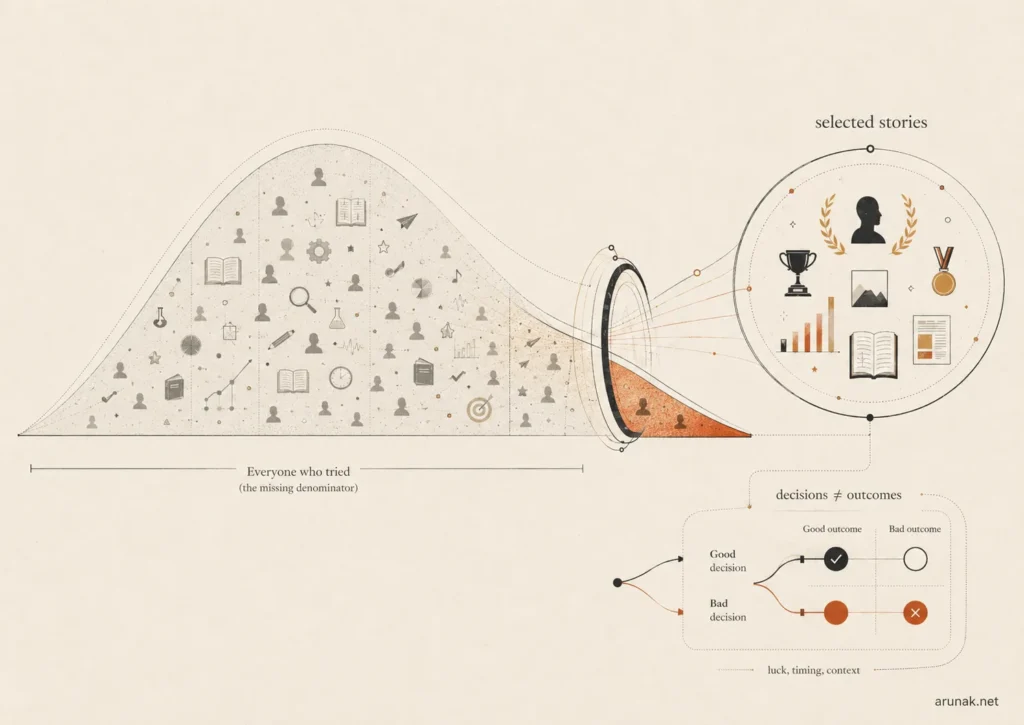
Let’s draw one example out of this book.
One of the central ideas in this book is the importance of deliberate practice, which is also a subject of many other similar non-fiction books these days.
But there’s a considerable amount of research showing that its effects do not have a major effect on an average person’s success. One meta-analysis found that deliberate practice explained 26% of the variance in performance in games, 21% in music, 18% in sports, 4% in education, and less than 1% in professions, and many other studies have arrived at the same conclusion.
What these results point to is that deliberate practice is useful, perhaps enormously useful, but not necessarily sufficient.
Which brings me to an even more uncomfortable part of this whole success-narrative paradigm: some of the factors, perhaps many of them, that define someone’s success are outside our control.
These could be the place you were born, family circumstances, health, access to apprenticeships and education, the people you happen to meet, and plain luck.
Success breeds success, or, as the scientists call it, “cumulative advantage“.
But you gotta wonder: even though there’s good evidence for all of this, why do writers continue to stick with success narratives?
Because the “raw reality” probably doesn’t sell nearly as well.
How the truth is delivered is almost as important as the truth itself. A statistical distribution of everyone who tried and failed doesn’t make much of a story. A person does.
So, the writers aren’t necessarily the ones to blame.
It all comes down to how the reader goes about reading these books.
The answer to this, I came to realize, came from another book: Thinking in Bets by Annie Duke. One of its central ideas is that the quality of a decision and the quality of its outcome are not the same thing. Good decisions don’t always produce good outcomes, and bad decisions don’t always produce bad ones, because uncertainty and luck sit between the two.
So when reading a book like Mastery, instead of concluding, “They did X, therefore X explains where they ended up”, a better question would be:
“What is useful for me to integrate into my own life from the decisions this person made, even if I remove the hyper-successful outcome from the equation?”
I wouldn’t be able to replicate the Mona Lisa by being at it for sixteen years straight, as Leonardo da Vinci did. Nor could I come up with the theory of natural selection by just spending roughly two decades on it, as Charles Darwin did. And I certainly couldn’t produce something like Mozart’s Symphony No. 41, the “Jupiter”, by just putting in the same “effort” as Mozart did.
That shouldn’t be the point.
Besides, they’ve already been done.
What we should aspire to do is use their best practices, methods, ways of thinking, and lessons from their mistakes to understand our respective domains better, become more efficient, become more socially intelligent, and produce exceptionally meaningful work in whatever we set out to do.
It’s all about decisions, not outcomes.
These stories shouldn’t be taken as recipes for our own success, but rather as exemplars for our own path to mastery.
The best practical lessons from “Mastery”
Seen that way, I find this book exceptionally useful for anybody looking to “up their game.”
All the stories and ideas in this book can be distilled into one continuous loop:
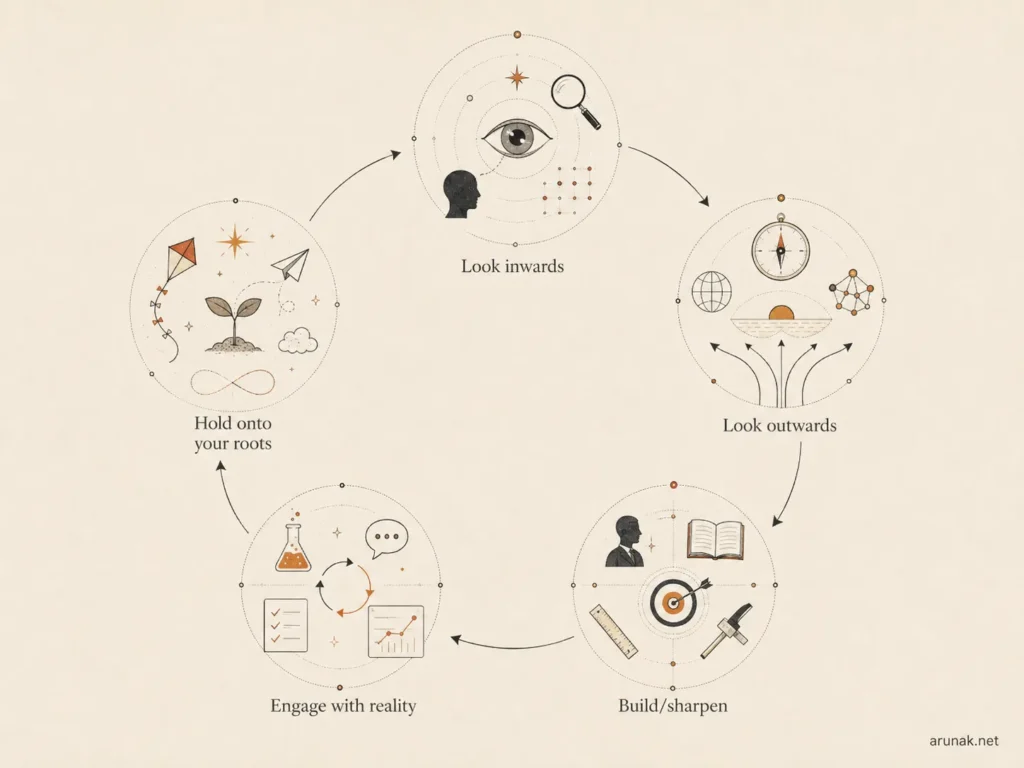
- Look inwards: Look for patterns and understand what excites you.
- Look outwards: Once you find what that is, look for fields where such a skill is valuable to other people, from the vantage point of that skill.
- Build/sharpen your skills: After aligning your skills with outcomes that other people would benefit from, it’s time to enter the apprenticeship phase, where you hone those skills to provide a better service to others and find mentors who can help shorten the learning process.
- Engage with reality: Test those skills in the real world and get feedback. Then adjust your skill set through that feedback loop.
- Hold onto your roots: The initiation of all this was simply excitement towards a certain subject or craft. Now that you’re a seasoned expert in it, in order to stay creative, you must continually reconnect with that childlike excitement that lured you into the field in the first place. This is what Greene calls the Dimensional Mind.
And, just like that, the loop is complete.
How Mastery changed the way I think
Other people’s success stories shouldn’t be taken as recipes for our own success, but rather as exemplars for our own path to mastery.