

About 8 years ago, I vividly remember getting so worked up about a speech I had to give in a couple of days. I knew the subject really well, and all the points I wanted to make, but I was still missing the most important element of all: how to start the damn speech.
Looking for solutions, I eventually came across a YouTube video that would eventually change how I start any speech or, for that matter, almost anything I say or write. It was a short talk by Conor Neill, a senior lecturer at IESE Business School.
“The best way to start a speech,” Neill says, “is the same way we start a story to a child.”
“Once upon a time…”
And it immediately made sense to me. Everyone loves a good story. Even when the boring stuff arrives later in the speech, the audience wouldn’t reach for their phones, because now they’re hooked. They want to know where this story leads.
The more I understood the benefits of this amazing trick, the more I began to notice it everywhere else. That includes most of the non-fiction books I’ve been reading for the past 5 years. Some of them are bad; some of them are good, but nonetheless, they all start with a story. And it’s often a good one. It grips me immediately. And then—and only then—the arguments follow.
Most of the time, this pattern continues through all chapters. The whole book runs through the success stories of the people who “made it”.
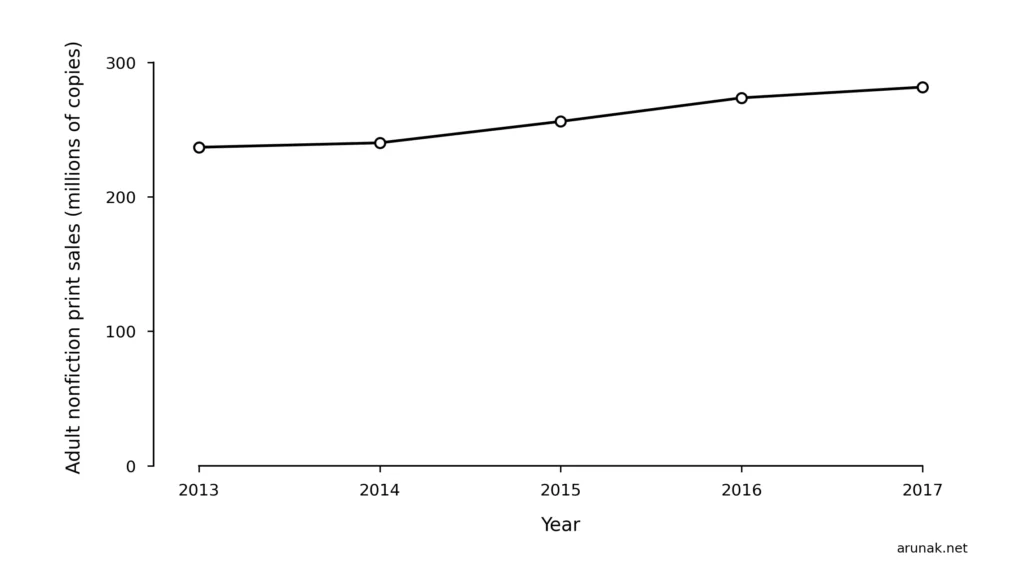
And this formula works. The appetite for non-fiction books has been on the rise since the 2010s. Between 2014 and 2018, the number of adult non-fiction books sold in the U.S. rose by 20.9%.
“As Morgan Housel, author of The Psychology of Money, said in an interview, ‘The best story always wins.’”
And this is a great deal for the reader, too, because we get to see how these ideas play out in the real world, through real people, with their real stories, which makes them stick in our minds so easily. We relate to other people far more than to ideas.
But on the flip side, with such a powerful narrative tool at work, it’s easy to overlook whether the book’s arguments actually hold up. For example, there’s always one question that keeps nagging at me when I read non-fiction books like this:
So, what about the people who did the same things and never made it?
Aren’t these stories cherry-picked? What about those who put in the same, or even more, effort, endured all the hardships, stayed at it for decades, and still never “made it”?
This is a methodological problem: you start with an outcome—say, billionaires, Nobel laureates, championship athletes, or highly successful entrepreneurs—and then work backwards to find their qualities that made them successful.
But if you take a random person who put in pretty much the same effort as someone from that successful group did, the probability is still pretty low that they’d end up hyper-successful.
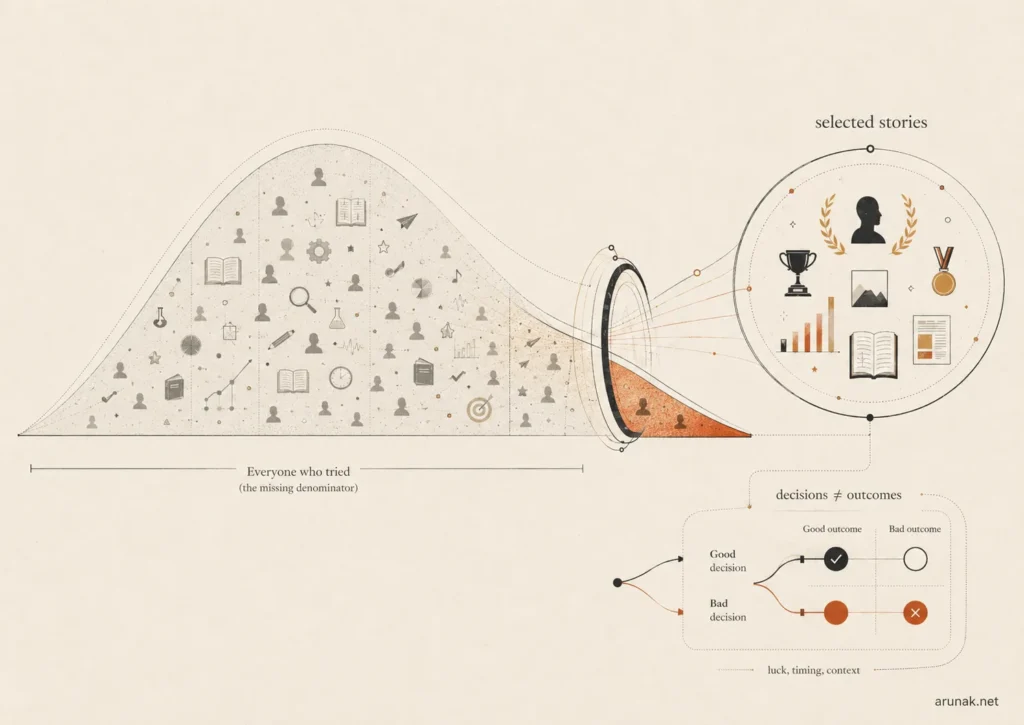
The problem with these “success narratives”, then, is the missing denominator.
For example, let’s take the book Mastery by Robert Greene. One of the central ideas in this book is the importance of deliberate practice, which is also a subject of many other similar non-fiction books these days (Bounce, Peak, Grit, So Good They Can’t Ignore You).
But there’s a considerable amount of research showing that its effects do not have a major effect on an average person’s success.1 What these results point to is that deliberate practice is useful, perhaps enormously useful, but not necessarily sufficient. This brings me to an even more uncomfortable part of this whole success-narrative paradigm: some of the factors, perhaps many of them, that define someone’s success are outside our control. These could be the place you were born, family circumstances, health, access to apprenticeships and education, the people you happen to meet, and plain luck.
Success breeds success.2
So why, even though there’s good evidence for all of this, do writers continue to stick with success narratives?
The answer becomes quite clear when you flip this question on its head: What would happen if writers accounted for all this complexity? What would happen if they presented the “raw reality” as is? If someone wrote a book like that, it probably would not sell nearly as well.
We already live in non-fiction. It’s not great. Why would you want to pay for a book that rubs your nose in it all over again?
So it’s quite natural that we crave some dose of optimism that only really exists in the extreme ends of real life. These books give it to us. That’s why they work.
All this said, there’s nothing wrong with these story-driven, success-skewed, non-fiction books, because how the truth is delivered is almost as important as the truth itself. A statistical distribution of everyone who tried and failed doesn’t make much of a story. A person does. So, the writers aren’t necessarily the ones to blame.
It all comes down to how the reader goes about reading them…
So how do we read these books while not distorting our view of reality?
One answer to this comes from another book that I recently read: Thinking in Bets by Annie Duke. One of its central ideas is that the quality of a decision and the quality of its outcome are not the same thing. Good decisions don’t always produce good outcomes. And bad decisions don’t always produce bad ones either. Uncertainty and luck sit between the two.
So, instead of concluding, “They did X; therefore X explains where they ended up”, we could ask:
“What lessons can I learn from this person and put to work on my own path to success?”
Now, that’s a better question.
Because I wouldn’t be able to replicate the Mona Lisa by being at it for sixteen years straight, as Leonardo da Vinci did. Nor could I come up with the theory of natural selection even if I spent two decades on it as Charles Darwin did. And I certainly couldn’t produce Symphony No. 41, by just putting in the same “effort” as Mozart did.
That shouldn’t be the point. Besides, they’ve already been done.
What we should aspire to do is use their best practices, methods, ways of thinking, and lessons from their mistakes to understand our respective domains better, become more efficient, become more socially intelligent, and produce exceptionally meaningful work in whatever we set out to do.
It’s all about decisions, not outcomes. To put it another way, these stories shouldn’t be taken as recipes for our own success, but rather as exemplars for our own path to mastery.
- One meta-analysis found that deliberate practice explained 26% of the variance in performance in games, 21% in music, 18% in sports, 4% in education, and less than 1% in professions, and many other studies have arrived at the same conclusion. ↩︎
- Scientists call this “cumulative advantage“. ↩︎