
One-line takeaway
Financial success is not a hard science; it’s a soft skill.
What is The Psychology of Money: Timeless Lessons on Wealth, Greed, and Happiness about?
The Psychology of Money makes a great case for the argument that doing well with money has little to do with how smart you are and a lot to do with how you behave.
Some other important lessons that I drew from this book are:
- Luck plays a greater role in finance than we give it credit for.
- Making money is easy; becoming financially independent is the hard part.
- The best of life is often lived in the mundane moments, which is where you should invest your money the most.
Ideas and takeaways
1. No One’s Crazy
Everybody, at any given moment, has a set of mental models through which they understand the world around them.1
These models might evolve with time through the experiences and the information they are exposed to over the years.
The experiences that we are subjected to are certainly different from those of others.
So when someone thinks investing in stocks is the best way to make money, while another thinks that’s the fastest way to lose it, nobody’s wrong.
Nobody’s crazy.
It’s just that their mental models about how the world works are quite different from each other.
2. Luck & Risk
Luck plays a greater role in financial success than people give it credit for. In the book Bounce, Matthew Syed makes a good case for this argument:
“Practically every man or woman who triumphs against the odds is, on closer inspection, a beneficiary of unusual circumstances.”
Keeping this in mind comes in handy when we study success stories of other people, especially when reading story-driven self-help books these days.
Doing the exact same things that successful people did does not yield the same results. Because luck plays out differently for different people.
But it’s the argument that Housel makes about risk that I don’t fully agree with.
He says:
When judging your failures I’m likely to prefer a clean and simple story of cause and effect, because I don’t know what’s going on inside your head.
Life is non-linear.
The rules of “cause and effect” do not hold in real life.
As Annie Duke, the author of Thinking in Bets, puts it:
“Life is poker, not chess.”
We can’t just make a good decision and hope everything will go well.2
The only thing that we have control over is providing a quality input: a good decision.
And success will eventually follow if we are making enough good decisions over a long period of time.
3. Never Enough
Modern capitalism is run by two major forces:
- Generating wealth
- Generating envy
They form an upward spiral.
The more money you make, the more money you want to make.
I also came to appreciate the way Housel broke down important economic principles in this section and explained them in a way that immediately makes sense.
The only way to know how much food you can eat is to eat until you’re sick. Few try this because vomiting hurts more than any meal is good (p. 54).
This is nothing but prospect theory, developed by Daniel Kahneman and Amos Tversky.
To be able to explain stuff with this much clarity is probably one of the reasons why this book has sold millions of copies.
4. Confounding Compounding
The effects of compounding—especially when trading stocks and/or bonds—seem so minimal, if not invisible, that we often underestimate its true potential.
It takes money to make money.
The most difficult thing to do in practice, then, is the easiest in hindsight: Wait.
Wait until your money compounds on its own.
As John Clifton Bogle, the founder of Vanguard, put it:
“Don’t do something, just stand there.”
5. Getting Wealthy vs. Staying Wealthy
Even if it sounds contradictory, getting wealthy is not the hard part; it’s keeping your wealth from going to waste.
6. Tails, You Win
Nobody is right all the time. But in order to be financially viable, it is really important to be able to make sound decisions at the tail ends of investing.
That’s where the money moves around a lot.
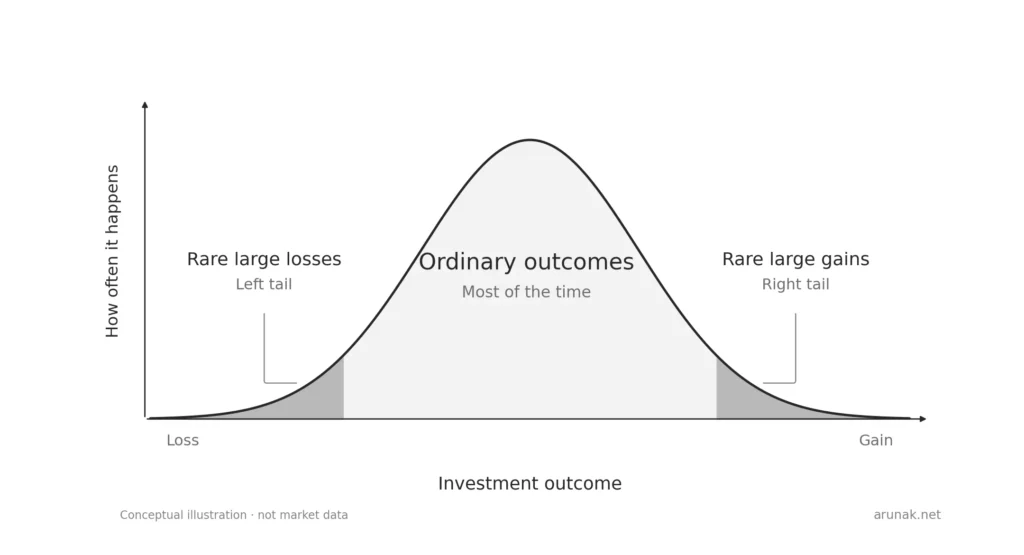
The genius of the best investor lies in how effective they are at getting the average things right when everybody around them is going crazy.
7. Freedom
The ultimate freedom is to be able to control your time. It is the ability to do whatever you want, whenever you want, as long as you want to do it.
8. Man in the Car Paradox
We admire the things that money can buy way more than the people who own them. So there’s no point in buying stuff that we don’t need to impress other people, because they are not impressed by you, but by the stuff you bought.
9. Wealth is What You Don’t See
The modern capitalistic economy lets us fake it until we make it. Oftentimes, this is a trap. They come in many shapes and forms: loans, unnecessary insurance, and the monthly instalments to buy the stuff you don’t need, to name a few.
Yes, you can drive home that shiny car today if you agree to pay $899 per month. But by the time you pay it in full, you’d be lucky if the depreciation of its value had stopped at half of the price that you bought it for.3
A pretty simple yet incredibly effective rule that keeps you rich is: don’t spend money that you don’t have.
10. Save Money
Even if you have a really good income, you’re not going to be wealthy if you spend it entirely at the end of the month on unnecessary purchases.
You’ll always have to start from zero the next month.
What makes you wealthy, then, is not decided by your paycheque, but by the gap between your paycheque and your ego.
Getting rich has more to do with your attitude towards money than with how much money you earn.
11. Reasonable > Rational
Some financial plans sound amazing on paper but do not hold up in real life. It’s nice to be able to drop $10,000 today into your investment portfolio, but it’s not the smartest decision to take it out of your emergency fund. What if you need that money next week for an emergency you never saw coming?
Instead, just depositing what you practically can—$200 per month for the next 24 months, for example—spreads out the financial risks more effectively.
12. Surprise!
There’s only one thing in economics that we can make a good prediction about: its unpredictability. Relying on historical data to predict the future is a fool’s game.
13. Room for Error
It’s always a good idea to make room for error when making financial decisions.
Those “what ifs” go further than we give them credit for.
14. You’ll Change
We live most of our lives in ordinary moments. The couple of hours that we have to enjoy with our loved ones between coming home from work and bedtime, a weekend getaway, or even a quick breakfast with your family in the morning are the moments when you live your life the most.
But while we are living in these moments, we don’t really realise how important they really are. They just seem to be normalities. But if you zoom out from this narrow view and see life as a whole, these are the primary building bricks that make up a life.
To live it fully, then, we should invest our money more in these extraordinary bits that we tend to see as quite ordinary through the sameness of everyday life.
15. Nothing’s Free
Why are people willing to spend an unnecessary amount of money on things that have no real value to them, but not willing to invest? A car, for example, depreciates in value over time, but investing does the complete opposite. And yet, we are happier to buy the shiniest car just to impress other people than to buy some stocks and invest.
The problem here is that making money from investing takes years, whereas you can drive the car home today after paying next to nothing.4
It’s the ability to see a couple of years ahead that really helps you become financially independent.
16. You & Me
Nobody knows more about your financial situation than you do.
The broker who suggests you buy their stocks does not know your financial plans for the next five years, the TV anchor who suggests you invest in bitcoins does not know your risk tolerance, and the celebrity who suggests you buy their meme coin definitely would not refund you when its value goes down!
You should be the one who’s driving your financial car because nobody knows all the controls better than you do.
17. The Seduction of Pessimism
We are more drawn to chaos than we are to order.
Pessimism is the fuel that runs our everyday life.
Tell someone that everything is going to be okay, and they will give you a side-eye, but tell someone that they’re in danger, and you’ll have their undivided attention.
People use this innate human nature to sell things you don’t really need.
So it’s important to have a rational mindset wrapped in optimism when making important financial decisions.
18. When You’ll Believe Anything
We are excited to hear stories. We are easily moved by them.
But to be able to keep our money secure, we should be able to keep this almost mythical desire of ours from clouding our judgements.
A good example of this is the 2008 economic crisis. It all started with a story that we were made to believe for years: housing prices would never go down.
Once the narrative that home prices will keep rising broke, mortgage defaults rose, then banks lost money, then they reduced lending to other businesses, which led to layoffs, which led to less spending, which led to more layoffs, and on and on (p. 207).
19. All Together Now
In this chapter, Housel fuses all the ideas from the previous ones to deliver a single message.
Financial success is not a hard science; it’s a soft skill.
It does not really matter if you have a PhD in economics or have made a million dollars. If you don’t tame your mind well enough, you’re not going to make much money, and you sure will not be able to keep the money already made.
It’s not just the ability to earn money, but your attitude towards spending it that makes you wealthy.
20. Confessions
Housel pointed out that the difference between what someone suggests you do and what they do for themselves isn’t always a bad thing, because there’s no such thing as a universal truth.
At the very end of the chapter, Housel shares some of his personal financial decisions: to buy a house without a mortgage, and to invest in a low-cost index fund, which actually influenced me to open my own.
- For more information on this, see my book note on Scarcity. ↩︎
- For more information on this, see my book note on Thinking in Bets. ↩︎
- Kelley Blue Book’s 2026 forecast estimates that an average new vehicle will retain about 45% of its original value after five years. ↩︎
- In Canada, CIBC offers up to 100% financing on new and used vehicles; Scotiabank’s Grad Auto Loan also offers 100% financing to eligible applicants. ↩︎