
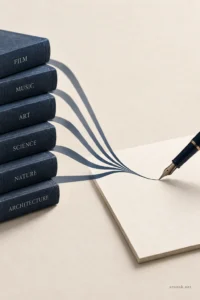
This week, I was going through some of the books I’ve read on “writing.”
Among others, my favourite is Steven Pressfield’s Nobody Wants to Read Your Sh*t.
Reading it again, I noticed something brand new: he spends an unusual amount of time talking about filmmaking.
Huh? That’s weird.
And it got weirder when I realized that other books about writing do exactly the same: Storycraft by Jack Hart, The Sense of Style by Steven Pinker, and Good Writing by Neal Allen and Anne Lamott, to name a few.
Understanding why learning other crafts helps us excel at our own, and how to draw useful connections between them: that’s what this week’s newsletter is about.
The Story phase: A pianist’s obsession with writing and painting
On August 10, 1892, Ricardo Viñes, a Spanish pianist, visited his friend Maurice Ravel’s home for a late afternoon chat.
Ravel, only seventeen at the time, was also a budding composer and pianist himself.
Viñes recalls that, after playing the piano together for a while, Ravel showed him a drawing he had made, inspired by Edgar Allan Poe’s A Descent into the Maelström.
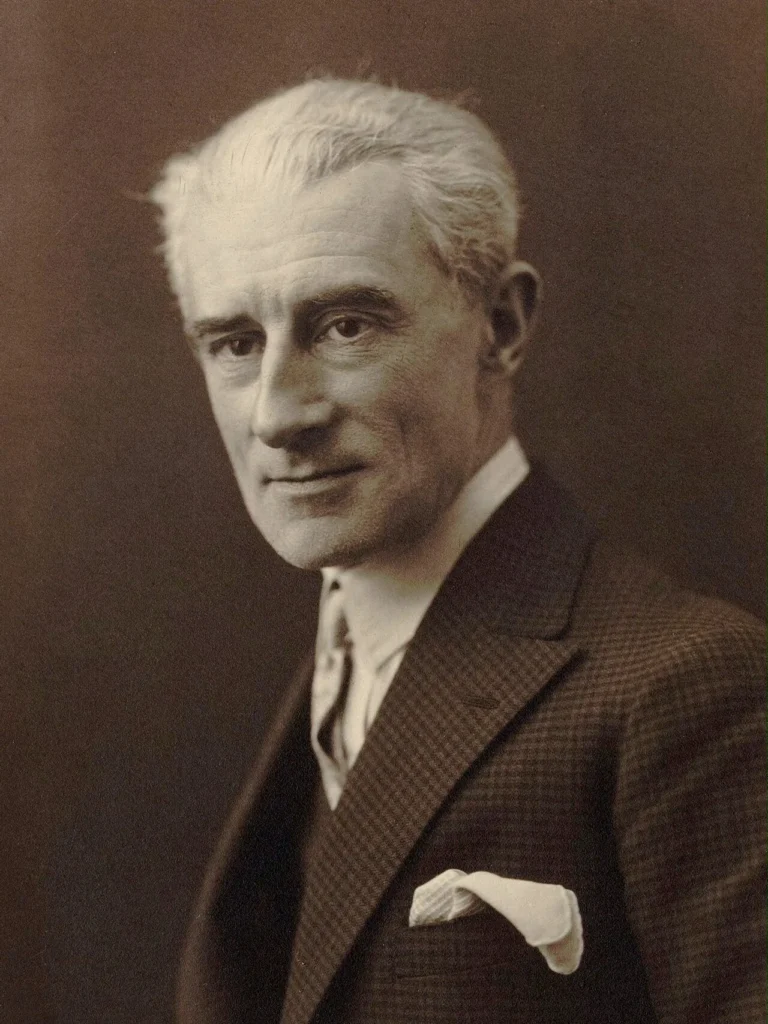
Viñes later writes about this interaction in his diary, wondering… why would someone pursuing a career in music show this much interest in a whole other art form?
Edgar Allan Poe was a renowned American writer, yes, but he was no musician.
It turns out that drawings weren’t the only inspiration Ravel took from Poe.
The Philosophy of Composition, which Poe published in 1846, Ravel mentioned, was the “treatise on composition” that had influenced him the most:
“As for technique, my teacher was certainly Edgar Allan Poe.”
Ravel went on to become one of the most celebrated composers of the twentieth century; by 2001, royalties from Boléro, his best-known orchestral work, alone were estimated at around £40 million.
How could learning across two such different domains have helped Ravel rise to such heights?
The Structure phase: The difference between a craft and an output
To answer this question, first, it’s necessary to separate the concepts of crafts from their outputs.
Writing, for example, is a craft. But the quality of a finished piece of writing, the output, depends on much more than the craft of writing itself.
It also relies on storytelling, pacing, scene construction, dialogue, and narration.
In that sense, any sort of creative output is often the result of numerous crafts working in harmony.
So, the skills needed to create a high-quality outcome come from different domains.
For example, here’s how Jack Hart—former managing editor at The Oregonian who helped edit several Pulitzer Prize–winning stories—draws on photography and filmmaking as a pathway to getting good at writing:
Photos show everything, but everything can be a confusing distraction. Not that visual storytellers don’t have their own techniques. Great photographers work hard to direct our eyes to significant details with composition and focus. Master filmmakers penetrate the confusion with tricks like the camera pan that lingers on a significant detail, singling it out as the “ominous object” that Hitchcock used to such good effect. When the camera swept over a room and paused on a paperweight, you knew the paperweight would figure in the tale (p. 92).
Seen this way, a craft is just a single point of view through which we can sharpen the output.
So, it is absolutely necessary to look beyond your own craft if you want to create something exceptional.
Because any type of great work rarely belongs to a single craft.
But how can you apply this in day-to-day life?
The interface: Domain mapping
Map out your work into other domains
Humans are social beings, and we have been for millions of years. This means our skills overlap so much that crafts rarely exist in isolation.
Look for another domain that solves the same kinds of problems.
- As mentioned, there’s a lot to learn from photography that you can apply to improve your writing.
- A musician can learn a lot about pacing from filmmaking.
- An architect can master proportion by studying sculpture.
Put two and two together
After finding related domains, we’re ready to map them.
A good example of this comes from the design of Japan’s Shinkansen, one of the fastest trains in the world, reaching a whopping 300 km/h.

While designing the train, the engineering work slowed to a halt because of an unexpected problem: noise. The faster the train went, the more noise it made. Eiji Nakatsu, one of the engineers working on the Shinkansen, recalls:
One day, I happened to see a notice for a lecture in a newspaper; attending the lecture, I had the honor of meeting Mr. Seiichi Yajima, then an aircraft design engineer and also a member of the Wild Bird Society of Japan. From him I learned how much of current aircraft technology has been based on studies of the functions and structures of birds.
I learned that the owl family has the most silent fliers of all birds. Some hawk species even make large noises on purpose when hunting – the sound functions to freeze their prey with fear. But somehow, an owl’s feathers emit virtually no noise. It seems that the owl family has acquired the function of “quiet flying” so that prey such as mice, will receive no warning that the owl is about to strike.
An engineer took a lesson from biology and applied it to an engineering problem that nature had already solved from a different point of view.
Know the limits of domain mapping
It’s quite tempting—and somewhat comforting—to try to map all the problems onto another domain like this, which could lead to its own pitfalls. Taken to the extreme, we might start seeing patterns that aren’t even there, sending us down dead ends.
No, cleaning your room doesn’t necessarily clear your mind or make you more productive!
So, domain mapping only works when applied with good judgment.