

The Story Phase
“Friedrich Nietzsche” is a name that’s no stranger to anyone even vaguely familiar with the world of literature. As brilliant as his work was, it has also stood the test of time. Even 126 years after his death, we still hear about his work in podcasts, books, lectures, and conversations every day.
But, as in any other writer’s career, he had his fair share of ups and downs, one of which came around 1881.
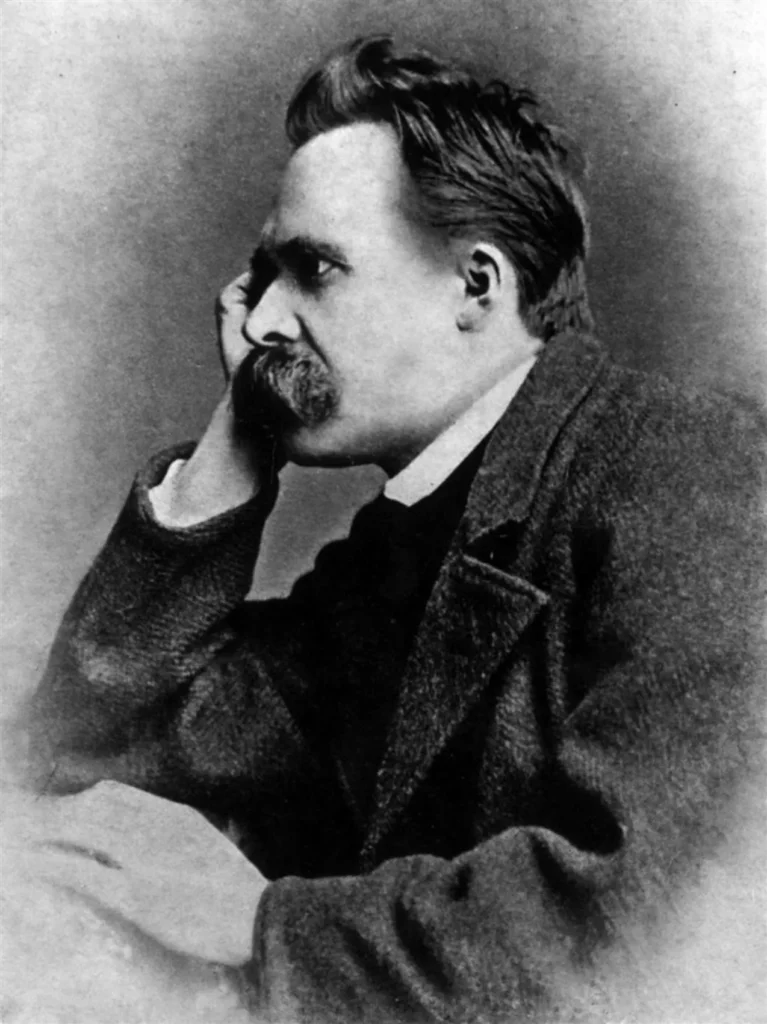
Two years earlier, his health had deteriorated so badly that he could no longer hold onto his position as a professor of classical philology at the University of Basel.
So he resigned.
While he was grappling with headaches, nausea, and digestive problems, he realized that his eyesight was also slowly fading.
A disastrous development for anyone, but even more so for a writer.
So he had to act fast.
He packed up his belongings and moved to a different climate, with a firm, if somewhat unusual, belief that temperature was the real culprit behind all of this.
Come winter, he moved to warmer places such as Nice, Genoa, and Turin. If the summer became too warm, he’d move again to cooler climes, his favourite destination being the Swiss Alps.
A strange decision to make, yes, but as it turns out, he was absolutely right about it.
Not only did his health improve dramatically, but he also found himself able to write more productively by controlling the climate around him.
Out of the many places he chose for this self-directed experiment, there was one small village on a high plateau in the Upper Engadine that he adored the most: Sils Maria.
“Here,” he wrote, “I feel better than anywhere else on earth.”
He’d return to Sils Maria for seven summers over the coming years, and during this period produced some of the work we now know him for, including parts of Thus Spoke Zarathustra, Beyond Good and Evil, On the Genealogy of Morality, Twilight of the Idols, and The Antichrist.
But the idea that “climate calms the mind” is as easy to romanticize as it is to dismiss.
The dynamics of it reach far beyond the “curl up with a good book on a rainy day” kind of sentiment.
Nietzsche returned to Sils Maria for one reason, and one reason only.
It wasn’t necessarily the “vibe” the village had to offer that drew him in; it was precisely the temperature.
A little bit of research tells me that the average summer temperature in Sils Maria is 12.3°C.
And as Nietzsche came to realize through his own trial and error, this was the optimum temperature that allowed him to be his most creative and productive self.
The Structure Phase
Let’s crunch some real numbers to see if there is such a thing as “the perfect temperature.”
When economic and population data from the World Bank’s World Development Indicators are merged with terrestrial temperature data from the University of Delaware climate dataset, they paint a pretty compelling picture: temperature, in fact, has a measurable grip on global productivity.
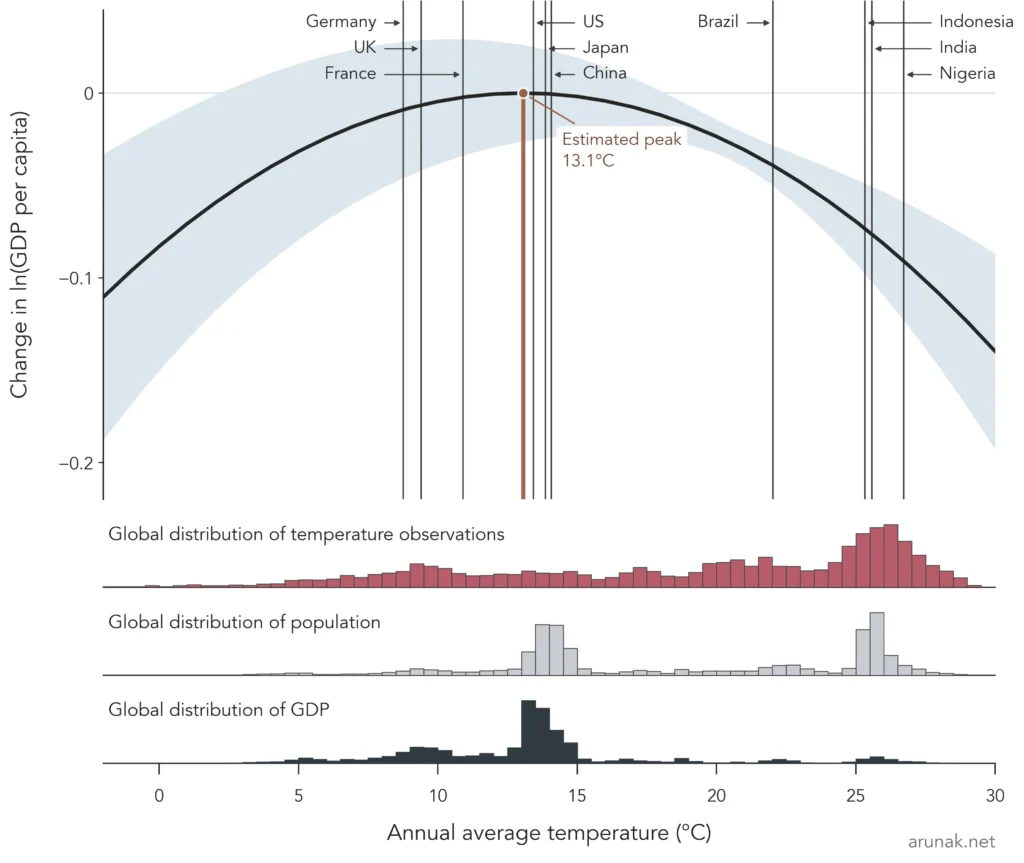
The calculations show—as shown in the figure—that the temperature at which the highest growth in GDP occurs is 13.1°C, and that on either side of this temperature, growth is comparatively lower.
Allowing for a 3°C margin on either side of this number, plotting average annual temperatures within this 10–16°C window shows that Sils Maria, too, is tucked into this temperature band.
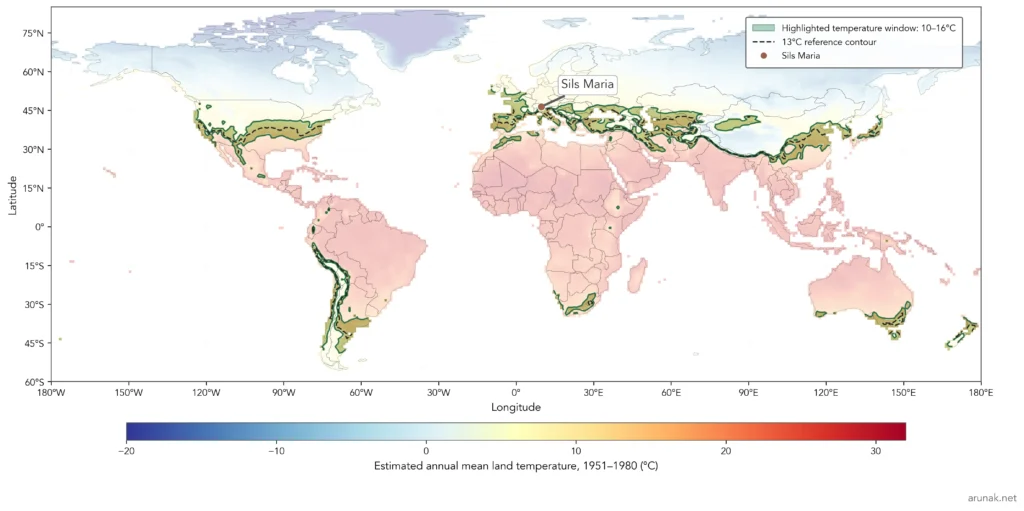
So yes, clearly, the effects of temperature on a global scale are not ignorable.
Zooming in on my own life—having lived in a tropical country where the average temperature sits at around 27–28°C and now living in a region where monthly average temperatures range from about 5.5°C in winter to 16.4°C in summer—I, too, have come to realize that there is a temperature at which I tend to perform at my best.
Mind you, I’m not making the argument that there is one optimum temperature that works across the board for everyone, nor that this is the only or dominant factor determining someone’s productivity.
That’d be absurd!
But I am, however, trying to emphasize the fact that productivity isn’t solely determined by the person; a productive day is proof that we’re focused and disciplined, while an unproductive one shows that we’re the ones to blame.
The data presented above show that things aren’t as “black and white” as we’d like to believe.
No matter how willing or determined you are to make the most of your day, the wrong environment can imperceptibly leach away so much of your energy that, by the end of it, you’ll wrongfully blame yourself for the work of an unseen culprit.
The Interface
But does this mean that, like Nietzsche, you’d become the most productive version of yourself simply by moving to a different place?
Of course not.
All the data presented in this essay describe what tends to happen on average. They show tendencies, not destinies. You’re just one person among the billions who make up that average.
That means there are billions of ways to deviate from it.
Here are some of them:
- Track the temperature where most of your work happens for about two weeks to gauge the range in which you tend to do your best work and seem to be highly focused and energetic.
- Change the microclimate around your workstation by using fans, a foot warmer, or a heated cushion.
- Make small adjustments to your workplace: move your desk away from direct sunlight, radiators, or cold walls, or make a point of adjusting the air conditioner if it’s under your control.
- Schedule the work that requires the most energy and focus during the hours when you’re naturally at your most productive self.
Because, come rain or come shine, the work must cross the finish line…