
The Story phase
On July 24, 1999, Stephen King sat down at a makeshift desk in the back hall of his house. Just five weeks earlier, he had been struck by a van while walking near his home in Maine. He’d undergone several operations by this point and had only recently begun learning to walk again.
Even sitting upright caused him intense pain.
His writing had come to a complete halt, and he wasn’t even sure that he could write anymore. And this was someone who used to write an average of 2,000 words a day. That’s roughly six manuscript pages.

And now, he’d be lucky if he could get a couple of words down on paper.
Explaining his state of mind at the time, he writes, “Feel like I’m drowning, I whisper.”
His wife, Tabitha, arranged his computer, printer, manuscript, notes, and a small fan on the table. Despite the excruciating pain, he began to type. The first five hundred words came slowly. By the end of the session, King was visibly exhausted. His body still hurt. But little by little, the words started appearing on his screen.
This little experiment, however, didn’t make him physically better. At least not at first. His injuries were still severe, and more operations were coming his way. But he took the fraction of strength he still had left and poured it into his writing.
And he kept writing…
With the return to a familiar routine came a sense of happiness.
Over the next couple of months, he’d go through another two operations. But he continued to write. Later, he recalled that this rebellious writing routine brought a “buzz of happiness” and “made his life brighter.”
King’s approach to returning to his work is all the more inspirational. But there’s another, somewhat elusive, lesson here. It’s our natural tendency to wait until everything gets back on track whenever life goes off the rails. We just wait for the pain to pass, the uncertainty to clear our, or things to “settle down” again. Only then, we think, can we go about living our best life.
But more often than not, things don’t settle that easily. Sometimes, it takes a long, long time.
Also, this “settling of things,” more than anything, is a state of mind.
It’s in our heads.
So, the best way to settle things when life is in disarray is to cling to something you would’ve done on a normal day, giving yourself a familiar point of reference.
The Structure phase
Think about a mooring line, which secures a ship while it’s exposed to the water. Wind and currents push against the ship all the time. The vessel rises and falls with the water. The job of the mooring line is to restrain this movement so the ship isn’t carried freely away.
But mind you, its job isn’t to calm the water. That’s impossible.
It simply gives the ship a point of attachment, allowing it to remain stable amid the surrounding turmoil.
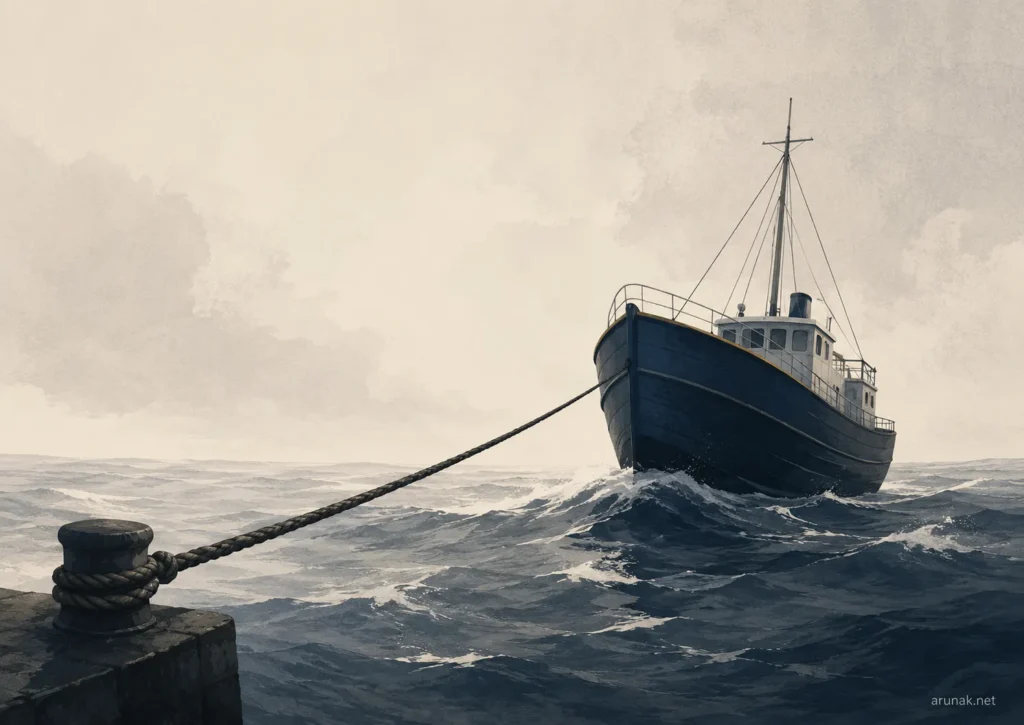
Our daily lives are sometimes like vessels caught in rough water.
A plethora of tasks continuously demands our attention. Maybe things aren’t going well with your boss, or you can see that your bank account is slowly going downhill.
These things often happen so gradually, while you can do so little to fix them immediately, that it can almost feel as though you’re slowly drowning.
But the truth is, you’re not.
It’s just a little turbulence.
All you have to do is hold on to something until it passes. All you need is a mooring line…
And the beauty of this process is that the benefit of it is mostly psychological. You don’t really have to achieve much by doing it. It could be as simple as making your bed every morning.
Admiral William H. McRaven, a retired four-star U.S. Navy admiral and former Navy SEAL commander, said during his 2014 commencement address at the University of Texas at Austin: “If you want to change the world, start off by making your bed.”
It could also be:
- taking a twenty-minute walk every morning,
- watering your plants,
- preparing a cup of coffee before lunch,
- writing one page in a journal,
- tidying your desk before you start working for the day,
- cooking dinner,
- or calling someone you care about.
For me, the mooring line has, for the longest time, been reading fifty pages per day.
There have been many days when I went to bed very early because I needed a break from an exhausting day, and then again woke up later and read my fifty pages.
And it works.
It doesn’t solve the things I was spiralling over during the day. Of course not. But it gives me the reassurance that, whatever goes wrong, I still have control over my day. It gives me something to hold on to until things settle down.
A little bit of resilience against the rough tides can go a long way.
The Interface
So, what are your mooring lines when everyday life is trying to throw you off balance?
Let me know in the comments.
References
Hou, W. K., Liang, L., Hougen, C., & Bonanno, G. A. (2021). Regulatory flexibility of sustaining daily routines and mental health in adaptation to financial strain: A vignette approach. International Journal of Environmental Research and Public Health, 18(6), 3103. (MDPI)
International Maritime Organization. (2025). Revised guidance on shipboard towing and mooring equipment (MSC.1/Circ.1175/Rev.2). (Register IRI)
Li, T. W., Liang, L., Ho, P. L., Yeung, E. T. F., Hobfoll, S. E., & Hou, W. K. (2022). Coping resources mediate the prospective associations between disrupted daily routines and persistent psychiatric symptoms: A population-based cohort study. Journal of Psychiatric Research, 152, 260–268. https://doi.org/10.1016/j.jpsychires.2022.05.033 (PubMed)
Meier, J., Kollmann, B., Meine, L. E., Meyer, B., Yuen, K., Stork, M., Tüscher, O., & Wessa, M. (2026). Perceived control as a resilience factor: Associations with neural, physiological and affective stress responses and mental health. Translational Psychiatry, 16, Article 39. (Nature)
Norton, M. I., & Gino, F. (2014). Rituals alleviate grieving for loved ones, lovers, and lotteries. Journal of Experimental Psychology: General, 143(1), 266–272. https://doi.org/10.1037/a0031772 (PubMed)